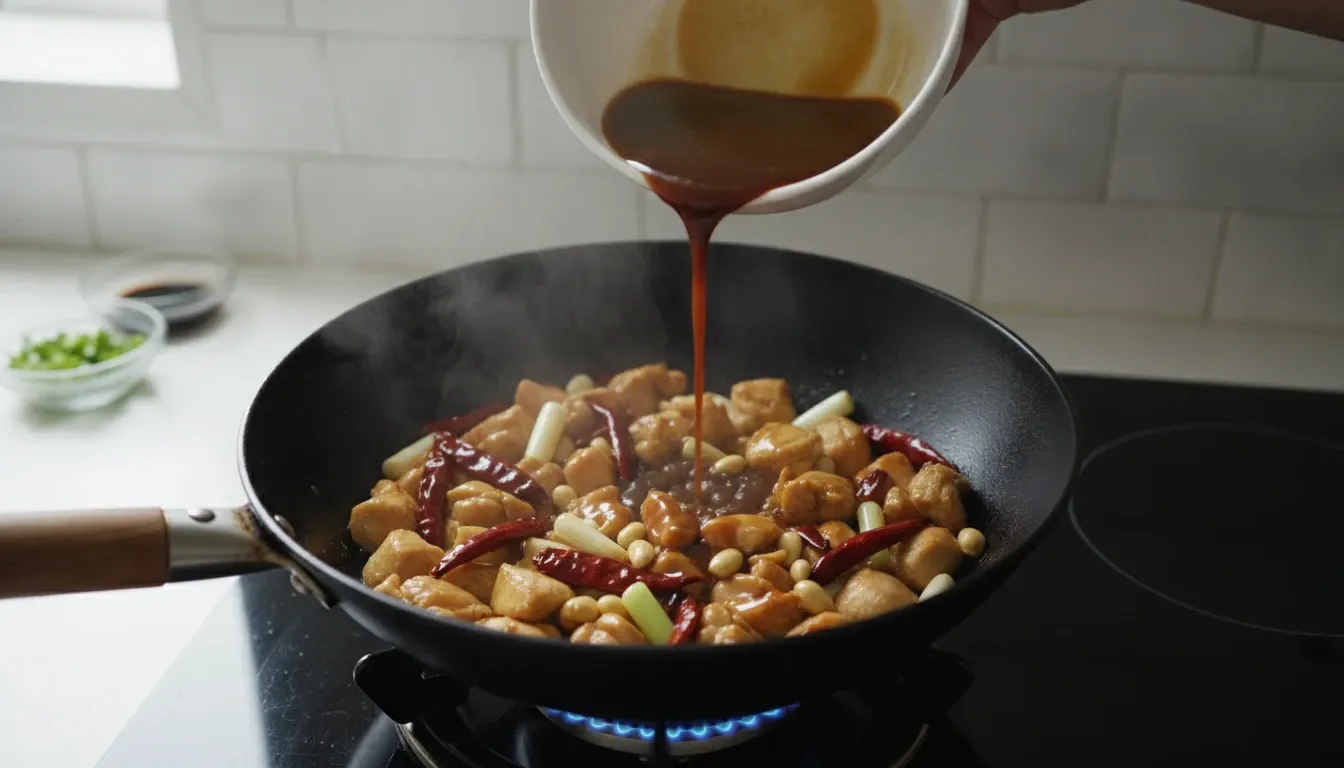
What this article answers
- What a Chinese bowl sauce is
- Sugar, vinegar, soy sauce and starch, plus wine or stock, mixed in a bowl and added once at the end
- Why mix it in a bowl first
- At home, 200 g of bean sprouts stir-fry in 60–90 seconds. Adding things one by one overcooks the food
- Fish-fragrant vs. Gong Bao (Kung Pao)
- The bowls are close. The difference is the chilies and aromatics fried in the oil first
- Making more or less
- Keep the ratio and scale the whole bowl. About 60 g of sauce for 200–300 g of food
- How it differs from Japanese ji
- Ji is a liquid the food soaks in. The bowl sauce coats the outside at the very end
Recipes for fish-fragrant pork (yu xiang rou si) tell you to mix sugar, vinegar, soy sauce, wine and starch in a small bowl before the wok goes on. Nobody measures seasonings one by one at the stove.
That is how Chinese cooks season a stir-fry: mix the sauce in a bowl, then pour it in once at the end. This article calls it the bowl sauce. Chinese cooks call it wan zhi (碗汁).
Each way of mixing it has a name, such as fish-fragrant, Gong Bao (Kung Pao) or sweet-and-sour. Chinese cooks call these names wei xing, or flavor profiles.
This article covers why to learn sauces by flavor profile, the ratios in the bowl for each, and why and when the bowl goes in.
Which taste leads and where to stop is covered in Wu Wei Tiao He. How to make Chinese stocks is in Chinese Stock Types.
Learn the flavor, mix ahead, add once
In the kitchen, there are four things to do.
| What to do | What it means | Guide |
|---|---|---|
| Learn it by flavor profile | Remember fish-fragrant, Gong Bao, sweet-and-sour: names for an order of leading tastes | Swap pork for eggplant, or chicken for shrimp, and keep the same tastes |
| Mix it in a bowl first | Put sugar, vinegar, soy sauce and potato starch in one bowl, with wine or stock | About 60 g of sauce (roughly 4 tbsp) for 200–300 g of food |
| Add it once at the end | When the food is cooked and fragrant, stir the bowl and pour | Turn off the heat once it boils, turns clear and goes glossy |
| Scale it to the food | Keep the ratio and scale the whole bowl up or down | On a home stove, stir-fry 150–200 g per batch and split the sauce too |
Sources: recipes for Gong Bao chicken and yu xiang xiao hua rou (references), Chinese Cooking Heat Control.
Flavor profiles name tastes, not dishes
Fish-fragrant has no fish in it
Fish-fragrant pork contains no fish. Fish-fragrant (鱼香) is the name of a flavor: pickled red chilies (salted and fermented), scallion, ginger and garlic, with sugar, vinegar and soy sauce. Accounts of where the name came from differ.
Because the name belongs to the flavor, not the main ingredient, the same profile turns up in many dishes.
| Flavor profile | Leading tastes | Dishes in the same profile |
|---|---|---|
| Fish-fragrant (yu xiang) | Salty, sweet, sour and hot all present, with a strong scallion, ginger and garlic aroma | Fish-fragrant pork, fish-fragrant eggplant |
| Gong Bao | Aroma and heat of scorched chilies, salt and umami. Sour comes first, sweet follows | Gong Bao chicken (gong bao ji ding), Gong Bao shrimp |
| Sweet-and-sour (tang cu) | Strong sweet and sour, with salt and umami at the finish | Sweet-and-sour spare ribs (tang cu pai gu), sweet-and-sour fish |
Sources: explanations of Sichuan flavor profiles (references).
Learn a sauce by dish name, and every new main ingredient means a new set of numbers. Learn it by profile, and when you swap pork for chicken, the order of tastes and the contents of the bowl stay the same.
Ingredients that soak up oil, like eggplant, turn fish-fragrant into a braise with added stock, and the sauce goes in differently (see the table of conditions below).
The name sets the tastes, not the ratio
In October 2025, 24 Sichuan flavor profiles were collected into an industry group standard. Reports say it sets a seasoning baseline and a flavor description for each.
This article couldn’t find the text of the standard, so its numbers are unchecked. Line up real recipes, and the sugar-to-vinegar ratio differs from one restaurant to the next. A profile’s name tells you which tastes lead and which support. It doesn’t give the ratio.
Bowl ratios, and Gong Bao vs. fish-fragrant
What real recipes put in the bowl
Here are the three profiles by weight in the bowl. Recipes written in spoons (1 tbsp = 15 ml, 1 tsp = 5 ml) were converted at 1 tbsp of granulated sugar = 12 g, 1 tbsp of liquid = 15 g, 1 tsp of soy sauce = 6 g, and 1 tsp of potato starch = 3 g.
| Profile (dish) | Food and amount | Sugar (g) | Vinegar (g) | Soy sauce (g) | Wine, stock or water (g) | Potato starch (g) | Sugar : vinegar |
|---|---|---|---|---|---|---|---|
| Gong Bao (Gong Bao chicken) | Chicken breast, 300–350 g | 12 | 15 | 12 | 15 | 2 | 4 : 5 |
| Fish-fragrant (yu xiang xiao hua rou) | Lean pork, 200 g | 20 | 15 | 15 | 10 | 5 | 4 : 3 |
| Sweet-and-sour (sweet-and-sour spare ribs) | Spare ribs, 500 g | 24 | 60 | 54 | 90 | 0 | 2 : 5 |
Sources: Gong Bao chicken (Dunlop); yu xiang xiao hua rou and sweet-and-sour spare ribs (Bendibao). Gong Bao uses Chinkiang black vinegar, fish-fragrant uses rice vinegar. The liquid is stock for Gong Bao, Shaoxing-type rice wine (huang jiu) for fish-fragrant, and 15 g of Chinese cooking wine plus 75 g of water for sweet-and-sour.
Dunlop’s Gong Bao splits its soy sauce into 1 tsp of light soy and 1 tsp of dark soy.
The sweet-and-sour ribs follow a version with cooking wine 1, sugar 2, soy 3, vinegar 4 and water 5, in tablespoons. In a version that swaps sugar and soy (sugar 3, soy 2), sugar to vinegar is 3 : 5.
Gong Bao has a little more vinegar than sugar, and is described as sour first, with sweet following. Fish-fragrant has more sugar than vinegar, and is described as sweet, sour and hot in balance. Sweet-and-sour uses a lot of both sugar and vinegar for the weight of food, so those two lead.
The difference is what goes into the oil
Look only inside the bowl, and Gong Bao and fish-fragrant have the same cast: sugar, vinegar, soy sauce and starch, with wine or stock. What sets them apart is what you fry in the oil before the sauce goes in.
| Profile | Fried in the oil first | What the oil adds |
|---|---|---|
| Gong Bao | Dried chilies and Sichuan pepper | Scorched-chili aroma and the numbing of Sichuan pepper |
| Fish-fragrant | Pickled red chilies (pao la jiao), scallion, ginger, garlic | Red oil from the chilies and a strong aromatic smell |
| Sweet-and-sour | Nothing | Only the browned flavor of the seared or fried food |
Sources: Gong Bao chicken (Dunlop), yu xiang xiao hua rou (Bendibao).
Gong Bao chicken uses about 10 dried chilies and 1 tsp (5 ml) of Sichuan pepper for 300–350 g of chicken. Yu xiang xiao hua rou uses 30 g of pickled chilies for 200 g of pork. So you remember two things: the sugar-to-vinegar ratio in the bowl, and the set of things fried in the oil first.
To infuse oil with aroma, scallion or garlic oil wants 100–150°C (212–302°F), and Sichuan pepper 150–180°C (302–356°F).
Sweet-and-sour braises skip the bowl
For sweet-and-sour spare ribs, the ribs are browned first. Then the mixed liquid is poured in just to cover them, and they simmer. When the liquid has dropped and starts to bubble, the heat goes up to reduce it. No starch goes in: the reduction thickens it.
Vinegar added early and boiled loses its sharp edge (Wu Wei Tiao He). The ribs carry more than twice as much vinegar as sugar, but the recipe simmers the vinegar for a long time and reduces it.
Dishes that cook sweet and sour together, like sweet-and-sour pork, also put the vinegar in early and boil it to soften it before the sweetness joins. Vinegar goes into a bowl sauce added at the end only for stir-fries that should stay sour, like Gong Bao and fish-fragrant.
Why the sauce is mixed ahead
Two additions overcook the food
On a home stove, stir-fry 150–200 g per batch. With 200 g of bean sprouts that takes 60–90 seconds, and they go onto the plate before juice shows on the wok bottom (Chinese Cooking Heat Control).
Measure sugar, vinegar, soy sauce and wine one at a time in that window, then add a starch slurry, and the food stays in the wok longer. The meat shrinks and toughens.
Shanghai cooks call seasonings mixed into the starch slurry wei qian. They use it in stir-fries of foods that toughen when overcooked, like pork liver and pork kidney.
Chinese restaurants mix some of the day’s sauces in the morning. When orders pile up, there is less to do at the wok.
Starch in the bowl makes the sauce cling
Potato starch gelatinizes at 55–80°C (131–176°F). Its granules take up water and swell, and the liquid thickens. When the bowl sauce hits the hot wok and boils, the starch turns clear, the sauce thickens, and it wraps around the food.
Sauce without starch runs off the food to the bottom of the wok. The flavor stays on the food because the thickened sauce holds it there.
The recipes here use potato starch. Cornstarch also works, but it thickens less and needs more heat. Use 1 tbsp (15 ml) of cornstarch in place of 2 tsp (10 ml) of potato starch, and bring the sauce to a full boil.
When the bowl sauce goes in
Stir the bowl, then pour it all at once
Gong Bao chicken and yu xiang xiao hua rou both add things to the wok in the same order.
| Step | What goes in | Cue to move on |
|---|---|---|
| 1 | What gets fried in the oil first (dried chilies and Sichuan pepper, or pickled chilies) | The chilies smell fragrant before they blacken. With pickled chilies, the oil turns red |
| 2 | The marinated meat | The meat turns white |
| 3 | Scallion, ginger, garlic | They smell fragrant |
| 4 | The bowl sauce (stirred up from the bottom just before pouring) | It boils, turns clear and goes glossy |
| 5 | Ming you, the finishing oil (only in some dishes) | Drizzle it in, then plate at once |
Sources: Gong Bao chicken (Dunlop), yu xiang xiao hua rou (Bendibao).
Starch doesn’t dissolve in water. It sinks to the bottom of the bowl. A sauce that has sat for a while has starch settled at the bottom, so stir it just before you pour.
Ming you goes in after the sauce thickens
Ming you, oil drizzled over at the end, goes in after the bowl sauce has thickened. Use it only where you want gloss and aroma: ½–1 tsp (2.5–5 ml) for one serving of stir-fry.
How much sauce, and counting the salt
About 60 g for 200–300 g of food
Gong Bao chicken uses about 60 g of sauce (including 1 tsp, or 5 ml, of sesame oil) for 300–350 g of chicken. Yu xiang xiao hua rou uses about 65 g for 200 g of pork. So the guide is about 60 g of sauce, roughly 4 tbsp (60 ml), for 200–300 g of food.
For more food, scale the whole bowl and keep the ratio. A home stove handles 150–200 g per batch, so a recipe for 300 g means two batches of food, each with half the sauce.
Count the salt in soy sauce and chilies first
Salt should come to about 1% of the whole dish (Wu Wei Tiao He). The soy sauce in the bowl, the soy sauce and salt in the marinade, and pickled chilies or doubanjiang (chili bean paste) all carry salt.
Count those first, and add salt to the bowl only for what is missing. The sauce thins out once it spreads over all the food, so taste it in the bowl and make it a little strong.
Three oils versus the bowl sauce
Four Chinese techniques share the same stir-fry wok.
| Technique | What it brings | When it goes in |
|---|---|---|
| Shu you | Oil with its raw smell driven off | The oil is prepared before you cook |
| Flavored oil | Aroma infused into oil | Made ahead, used in stir-fries and dressed dishes |
| Bowl sauce | Flavor and thickening, mixed to a ratio | Once, at the end of cooking |
| Ming you | Oil for gloss and aroma | After the sauce thickens, just before plating |
Shu you removes the oil’s off-smells. Flavored oil and ming you carry aroma and gloss. The bowl sauce carries sweet, sour and salt.
When a dish needs sweet-sour flavor, use the bowl sauce. When it needs aroma and gloss, use flavored oil and ming you. In the wok, the order is: start with shu you or flavored oil, add flavor and thickening with the bowl sauce, and finish with ming you.
Japanese ji soaks in, bowl sauce coats
Japanese cooks also mix seasonings to a ratio ahead of time. Such a mixed liquid is called ji. Happo dashi is one: dashi, the Japanese stock of kelp and dried bonito, mixed with soy sauce and mirin, a sweet rice wine for cooking. What differs is what the name refers to, how much liquid there is, and where the flavor goes.
| Japanese ji (happo dashi) | Chinese bowl sauce | |
|---|---|---|
| What the name refers to | The ratio (dashi 8 : soy sauce 1 : mirin 1) | The order of leading tastes (fish-fragrant, Gong Bao) |
| Amount of liquid | Enough to cover the food | About 60 g for 200–300 g of food |
| Main liquid | About 8 parts in 10 are dashi | Sugar, vinegar and soy sauce, with a little wine or stock |
| How it’s used | Simmering, steeping | Stir-frying, coating |
| Where the flavor goes | Into the food | Onto the outside, held by the thickening |
The name happo dashi is its ratio. A flavor profile’s name is the order of tastes, and the ratio lives in each restaurant and recipe.
Ji puts flavor into food by soaking it in liquid. The bowl sauce coats the outside at the end with a small amount of strong, thickened sauce. Sweet-and-sour ribs, simmered in liquid that covers them, are used more like ji.
When to change the method
| When | What to do | Why |
|---|---|---|
| The food is over 200 g | Stir-fry it in two batches and split the sauce | A home stove handles 150–200 g per batch |
| Making fish-fragrant with an oil-hungry food like eggplant | Make it a braise with stock: add stock and sugar, then starch slurry, then vinegar | It simmers long enough that one premixed bowl isn’t needed |
| You want the sourness to stay (Gong Bao, fish-fragrant stir-fries) | Put the vinegar in the bowl sauce and plate as soon as it turns clear | The vinegar boils only briefly |
| You want the sourness rounder (sweet-and-sour ribs, sweet-and-sour pork) | Add the vinegar to the wok early and boil it | Boiling drives off the vinegar’s sharp edge |
| Using doubanjiang instead of pickled chilies | For each 1 tbsp (15 ml, about 20 g) of doubanjiang, cut soy sauce in the bowl by the equivalent of about 2.4–3.6 g of salt | Doubanjiang is 12–18% salt, so the salt doubles up |
Sources: fish-fragrant eggplant (Dunlop), Chinese Cooking Heat Control, Wu Wei Tiao He, and this site’s notes on doubanjiang.
Common failures and fixes
Lumps and tough meat can be only partly saved. A sauce that won’t cling, oversalting and thinning in acid can all be fully fixed.
| Problem | Cause | Fix it now | Prevent it next time |
|---|---|---|---|
| The sauce is lumpy | The starch was still settled at the bottom of the bowl. It ran in last and gelatinized in clumps in the hot wok | Lower the heat and stir quickly to break it up. Scoop out any lumps that remain | Stir the sauce up from the bottom just before it goes in |
| The sauce won’t cling | The heat went off before the sauce boiled and turned clear, so the starch never gelatinized and the sauce ran to the bottom | Turn the heat back to high, bring it to a boil, and stir until the sauce is clear and glossy | Once the sauce is in, keep the wok on the heat until it boils and turns clear |
| The meat is tough | Seasonings went in one at a time, then the starch slurry. Meanwhile the meat’s proteins shrank in the heat, lost water and toughened | Take the food out onto a plate. Boil the sauce until it thickens, then return the food and toss it quickly | Mix seasonings, starch and stock in a bowl ahead, and add them once at the end |
| It’s too salty | Salt went in without counting the salt in soy sauce, pickled chilies and doubanjiang, so it passed 1% of the whole dish | Add unsalted food, such as boiled vegetables or tofu, to dilute it | Count the soy sauce in the marinade and sauce and the salt in the chilies first, then add only the salt still missing |
| The thickening loosens in the acid | It kept simmering long after the sauce went in, and the vinegar’s acid cut the starch network | Add a little more starch slurry, and plate as soon as it boils and turns clear | Once the sauce is in, turn off the heat as soon as it is clear and glossy |
Four things to remember
A Chinese stir-fry sauce is a ratio, learned by flavor profile, mixed in a bowl ahead and added once at the end.
- A profile’s name gives the order of leading tastes. The same bowl sauce works with other main ingredients
- Gong Bao and fish-fragrant are close inside the bowl. The difference is what’s fried in the oil first: dried chilies and Sichuan pepper, or pickled chilies with scallion, ginger and garlic
- The bowl is mixed ahead because a home stir-fry is over in 60–90 seconds. Stir it just before pouring, and turn off the heat when it turns clear
- About 60 g of sauce for 200–300 g of food. Scale the whole bowl and keep the ratio, and count salt to about 1% of the whole
For braised dishes, the same profile skips the bowl: the vinegar goes in early and the food simmers in liquid that covers it.
Sources
- China Securities Journal. Group standard "Sichuan cuisine compound flavor profiles: twenty-four flavors" released (October 21, 2025, Chengdu; initiated by the Sichuan Condiment Association, drafted by Sichuan Tourism University). On the number of flavor profiles and their standardization (in Chinese)
- Maigoo. Sichuan flavor profiles. On the seasonings and character of yu xiang, tang cu, lizhi, hula and other profiles (in Chinese)
- The Mala Market. Lizhi wei. On Gong Bao as a combination of hula and small lizhi, and lizhi using slightly less sugar than vinegar
Show 6 more
- WildChina. Fuchsia Dunlop's Gong Bao Chicken Recipe (from Every Grain of Rice). On the sauce quantities, including light and dark soy and Chinkiang vinegar, and when it goes in
- Andrew Zimmern. Fuchsia Dunlop's Fish-Fragrant Eggplant. On quantities, and the order of stock, starch and vinegar
- Bendibao. Yu xiang xiao hua rou. On the sauce quantities, and adding it last and stir-frying until glossy (in Chinese)
- Bendibao. Tang cu pai gu (sweet-and-sour spare ribs). On the 1:2:3:4:5 ratio of cooking wine, sugar, soy, vinegar and water, and simmering in enough liquid to cover, then reducing (in Chinese)
- The Paper (Food and Life). Qiao Zhiyuan. Shanghai-style starch sauces show a cook's skill. October 28, 2023. On wei qian, seasonings mixed into the starch slurry and added in one step (in Chinese)
- America's Test Kitchen. Can potato starch be substituted for cornstarch to thicken sauces? (potato starch thickens more and faster; 2 tsp potato starch for 1 tbsp cornstarch)