What this article answers
- What defines French cooking
- Finishing with sauce, standardizing technique by name, and choosing ingredients by where they were made
- How it differs from Japanese cooking
- Flavor goes in through a sauce made in a separate pan, not the simmering liquid, plus 16–28 g of butter per dish for 2
- How it differs from Chinese cooking
- Flavor isn't coated onto the food. It meets the food on the plate as a sauce
- Is sauce there to hide the ingredient?
- No. Escoffier says meat and sauce must be in harmony. Sauce adds the moisture, fat, and acid the ingredient lacks
- Home French cooking tastes flat
- Before adding more butter, deglaze the pan with wine or fond and reduce for 4–5 minutes
French food is often described as a cuisine of sauces, with lots of butter and wine. But Japanese cooking has ji (地), seasoning liquids mixed in advance. Chinese cooks finish with a swirl of oil and splash Shaoxing wine into the wok.
So what belongs to French cooking alone? Line the three cuisines up, and the difference lies less in the features than in how they are used, and how much.
This article sets French cooking beside Japanese and Chinese cooking on the same scale. It shows where they differ, and where they point in opposite directions.
Three values and five tools
French cooking holds three values. It finishes the plate with a sauce. It standardizes technique by name and procedure. It chooses ingredients by the name of the place they come from.
Five tools put these into practice in the kitchen. Heat is matched by technique names. Pan-cooking is split into 11 words. Bases are prepared ahead. Dairy fat finishes the dish. Wine becomes the braising liquid. The table lays all 8 beside Japanese and Chinese cooking.
| Feature | What is compared | French cooking | Japanese cooking | Chinese cooking |
|---|---|---|---|---|
| Finishing with sauce | Where flavor goes in | A sauce made in a separate pan, joined on the plate | All at once in ji, during simmering | Bowl sauce (premixed in a bowl), added last to the outside of the food |
| Codifying by name | What gets a name | Cuts, pan-cooking methods, sauces, garnishes, kitchen stations | Ratios of seasoning liquids | The shape and size of cuts |
| Choosing by origin | How one ingredient is told apart | Where and how it was made | When it was caught | The eater’s body and the season |
| Heat control | How heat is described | By technique names | Whether the liquid boils or not | Four flame levels and a scale of oil temperatures |
| 11 pan-cooking words | How pan-cooking methods are named | A new noun for each change from sauté | One verb, “yaku,” with adverbs added | Stir-fry names such as chao and bao |
| Prepared bases | What is made ahead and kept | Fond, glace, and roux, each separately | Little is kept. Dashi is made on the day | One pot of mao tang (chicken or pork bone stock) |
| Butter and cream | Fat added to finish (one dish for 2) | 16–28 g of butter or cream | 0 g | 4–10 g of ming you (finishing oil) |
| Wine | Alcohol in the braising liquid | 300 ml of wine per 1 kg of meat | 50 ml of sake per 500 ml of dashi (in happō-dashi) | 75–150 ml of Shaoxing wine per 1 kg of meat |
Sources: the comparison sections of this site’s articles on each feature. For the Japanese and Chinese side, this site’s articles on Japanese cuisine, Chinese cuisine, and Chinese heat control.
Sauces, names, base liquids, and alcohol exist in every one of these cuisines. What differs is where flavor goes in, and how much fat and alcohol go in at the end. For choosing ingredients, the criterion itself differs.
Sauce, names, and where food comes from
Sauce adds what the main ingredient lacks
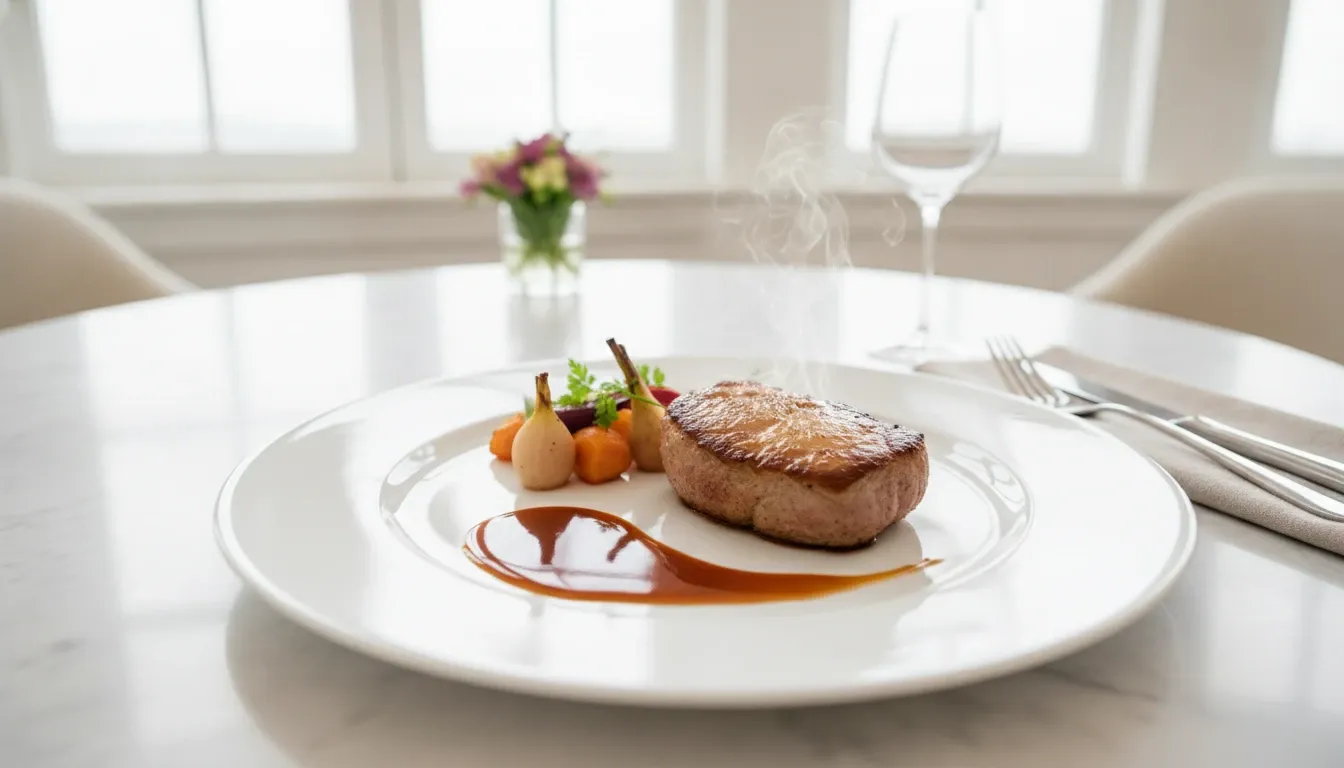
French food is sometimes said to bury the ingredient under a dominant sauce. The source text says the opposite. Escoffier’s Le Guide Culinaire tells cooks to bring meat and its sauce into harmony.
A sauce is a liquid that adds the moisture, fat, and acid that a grilled or poached main ingredient lacks. It is chosen anew for each one.
Grilled red meat gets bordelaise, made by reducing 300 ml of red wine to 75 ml. Lean poached white fish gets hollandaise, made of egg yolk and butter.
Because the main ingredient and the sauce are made in separate pans, the same grilled beef can take béarnaise or bordelaise.
The fond (stock) is matched to the main ingredient too. Beef, pork, and duck take brown fond. Fish takes a fumet made from the bones of the same fish. Game takes a game fond.
Names reach the plate and the kitchen brigade
Japanese cooks name seasoning ratios, such as happō-dashi (dashi 8 : soy sauce 1 : mirin 1). Chinese cooks name cut sizes: ding (diced, 8–10 mm or ⅜ in) and si (shreds, 2 mm or 1/16 in wide).
French cooks named cuts and cooking methods, and also the combinations on the plate and the stations in the kitchen. À la bourguignonne means small onions, mushrooms, and bacon at 4:2:1 by weight, braised in red wine.
In the brigade, the saucier handles fonds and sauces. Calling out a dish name is enough to set each station moving. Escoffier wrote that this let a kitchen of 60 cooks send out orders for 400–500 diners in 1 to 1½ hours.
The same name means the same contents. So one word in a recipe stands in for several lines of steps.
Ingredients are chosen by where and how, not when
Japanese cooks change the dish with the season. Bonito, for example, carries 0.5 g of fat per 100 g when caught in spring, and 6.2 g in autumn.
Chinese cooks sort foods into cold, cool, neutral, warm, and hot, and choose by the eater’s body and the season.
French cooks choose by the name of the place. An AOP (protected designation of origin) name guarantees a way of making, such as at least 120 days of aging for Comté. It doesn’t rank flavor.
The aromas that come from that way of making are lost to heat. So AOP butter isn’t used for browning. It is melted into a sauce taken off the heat, at 45–55°C (113–131°F).
Named heat and bases, more fat and wine
Technique names point to a temperature
French cooks match heat by technique name rather than “high” or “low.” Pocher (poaching) keeps the liquid at 65–85°C (149–185°F). Braiser (braising) keeps it at 82–88°C (180–190°F). Sauter keeps the fat at 130–190°C (266–374°F).
Japanese simmered dishes divide heat by whether the liquid boils. Chinese cooks name four flame levels, from wang huo (high) to wei huo (very low), and count oil temperature on a scale called cheng (成). For five cuisines side by side, see Heat Control in 5 Cuisines.
Egg and butter sauces stop at a set point: beurre blanc at 55°C (131°F), hollandaise at 65°C (149°F), and crème anglaise at 84°C (183°F).
Pan-cooking gets 11 words, by what changed
Japanese has one verb, yaku, for all of it. Cooks add adverbs: over high heat, until browned, with a lid. French made a separate noun for each change.
The baseline is sauter: a frying pan, high heat, short time. Hotter, to brown only the surface, is saisir. Gentler heat, basting with melted butter until cooked through, is poêler. Fish dredged in flour and pan-fried is meunière.
Fond, glace, and roux are made ahead, separately
Liquids drawn from bones take time in every cuisine. Chinese cooks simmer mao tang over low heat for about 3 hours and keep one pot. Japanese cooks use kombu (dried kelp) and dried bonito, which give up their flavor quickly, and make dashi on the day.
French cooks give white fond 3 hours and brown fond 12 hours or more. They also keep glace (fond reduced to a syrup) and roux (flour cooked in butter for thickening), each made separately.
15 ml of glace with 135 ml of water makes the equivalent of 150 ml of fond. Use it to dissolve the pan juices, reduce for 4–5 minutes, and you have the day’s sauce.
16–28 g of finishing fat in one dish for 2
French cooks add 80–140 g of butter to 1 L of sauce at the end. For a 200 ml home sauce, that is 16–28 g.
Chinese ming you is ½–1 tsp (2–5 ml) per serving of stir-fry, so 4–10 g for 2. Japanese simmered dishes get none.
Melt the butter while the sauce is between 45 and 55°C (113–131°F). Above 60°C (140°F), oil beads rise to the surface and the sauce splits, so don’t boil it once the butter is in. More in French Butter and Cream, and in Ming You for the oil.
Wine goes in as the braising liquid, then reduces
For a braise, French cooks marinate 1 kg of meat in 300 ml of wine for 5–6 hours. They reduce that wine to a syrup, then braise the meat in fond.
Chinese cooks use 75–150 ml of Shaoxing wine for 1 kg of meat. The French amount is 2–4 times that.
Chinese cooks splash the wine onto the hot side of the wok and burn it off in an instant. In Japanese happō-dashi, sake is less than a tenth of the liquid.
French cooks keep the acid and color left after the alcohol cooks off, and make them part of the braising liquid and the sauce.
Cook apart, then add what’s missing
Read the 8 rows of the comparison table from the French side. They line up on one point: the main ingredient and the flavor are made separately, then joined on the plate.
Japanese cooks put flavor inside the food through the simmering liquid. Chinese cooks coat the outside of the food with a premixed bowl sauce at the end of a stir-fry.
French cooks keep fond on hand, make the sauce in a separate pan, build the braising liquid from wine, and add butter last. That is why the finishing fat and the wine run high.
Once you see this, what you fix in a flat-tasting French dish at home changes. Before adding more butter, pour off the fat from the pan where you seared the meat.
Pour in wine or fond until it covers the bottom, and scrape up the browned juices. Reduce for 4–5 minutes, until a line drawn across the pan bottom with a wooden spatula holds for a moment.
Take it off the heat and melt in cold butter 5 g at a time. The flavor that came out of that meat becomes the sauce. Not pouring the same sauce over everything is also part of French cooking.
Courses one by one, wine light to heavy
The order of courses and how wine is matched aren’t features in themselves. They are the features above, taking the shape of a table.
A French meal starts with an apéritif and serves starter, main, cheese, and dessert one plate at a time, ending with a digestif. Plates come one at a time because hot food set out together goes cold.
An everyday Japanese meal sets out one soup and three dishes (ichijū sansai) all at once. Chinese cooks serve large plates for everyone to share.
Wine follows the plates, from light white to heavy red, with sweet wine saved for dessert. A bottle pours about 2 glasses each for 4 people. So if you serve both white and red to 4, open a half bottle of each.
At home, keep the order and cut the number of plates. Serve only the main course hot, and make the starter and dessert ahead. Take the cheese out of the fridge 1 hour 30 minutes before.
Three things to remember
- French cooking finishes with sauce, standardizes by name and procedure, and chooses ingredients by place. It puts these into practice with heat, pan-cooking, prepared bases, dairy fat, and wine.
- Most of these exist in Japanese and Chinese cooking too. The difference shows in where flavor goes in, and how much fat and alcohol go in at the end.
- Sauce isn’t there to cover the ingredient. It adds the moisture, fat, and acid the main ingredient lacks, made in a separate pan and joined on the plate.
When home French cooking tastes flat, reduce the pan juices before you reach for more butter.
Sources
- Escoffier, A. Le Guide Culinaire, aide-mémoire de cuisine pratique (first edition 1903; quoted from the 2nd edition, Émile Colin) (in French). The general chapter on sauces (harmony between meat and sauce), fonds, and the rules for marinating and braising
- INAO. "Aires géographiques et délimitation des produits sous SIQO" (in French). The definitions of the AOP link to origin and of terroir
- UNESCO. "Gastronomic meal of the French" (inscribed in 2010 on the Representative List of the Intangible Cultural Heritage of Humanity)