What this article answers
- Why French cooks braise in wine
- Wine replaces water or fond as the liquid, and puts acidity, color, and aroma into the braise
- How much wine for a braise
- Marinate 1 kg of meat in 300 ml for 5–6 hours, then reduce that wine to a syrup before braising
- How far to reduce wine for a sauce
- From half down to a quarter. Finishing wine goes in off the heat
- How much alcohol stays after braising
- 25% after 1 hour, 5% after 2½ hours. Over 40% stays in a 4–5 minute pan sauce
A recipe for 1 kg of beef braised in red wine says: “Pour in a bottle (750 ml) of red wine, reduce by half, then add the fond.” Isn’t a whole bottle a lot? Why reduce it first? And doesn’t alcohol stay in after braising?
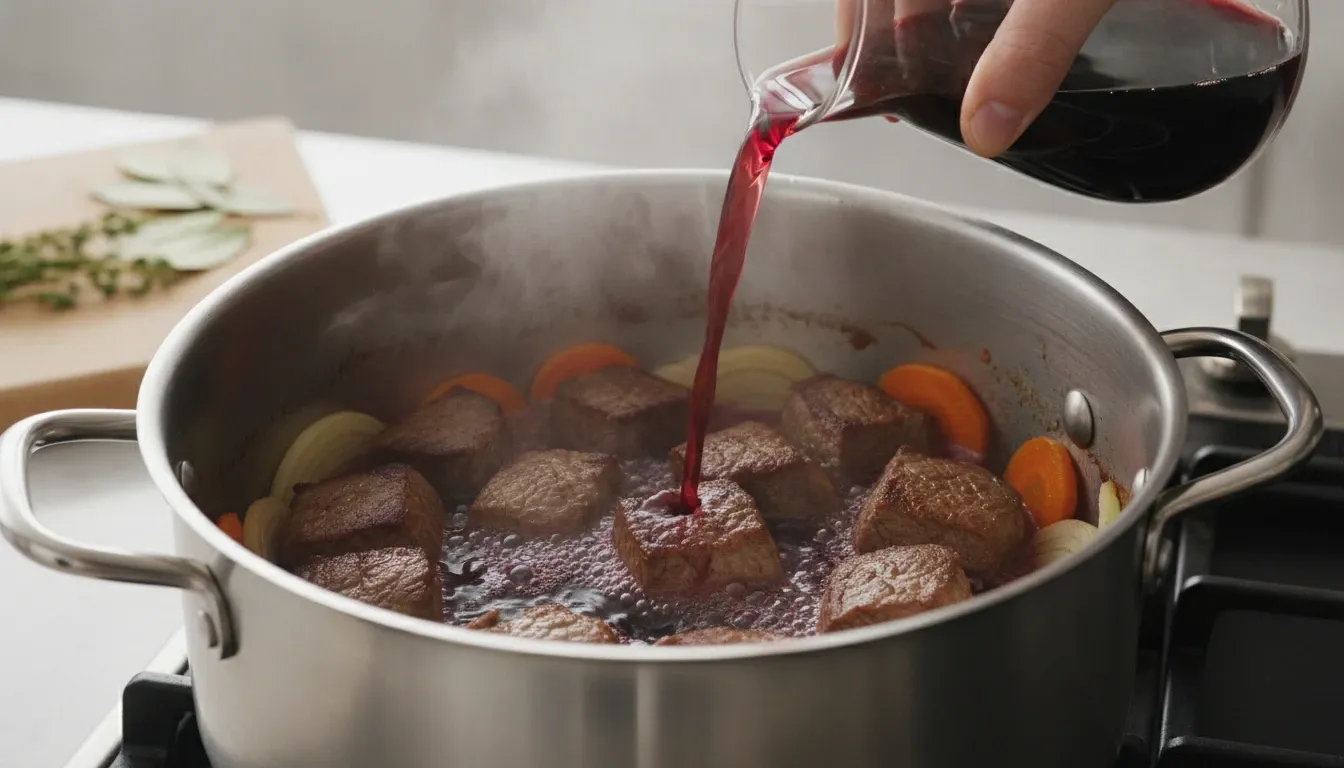
French cooking does not use wine as a splash of flavoring. It uses wine as the liquid that cooks the meat, in place of water or fond (stock).
Wine has four uses, and each has its own timing and its own point to stop reducing.
This article covers why French cooks make wine the cooking liquid, and which dishes get red or white. It also covers how much goes in, how far to reduce it, how much alcohol stays, and how this differs from Japanese and Chinese cooking.
How the prep work, wine, and butter and cream fit together in one pan is covered in preparing bases in French cooking and butter and cream in French cooking.
Wine replaces water as the liquid
Here are the steps where French cooking uses wine, with when it goes in, how much, and how far to reduce it.
| Use | When it goes in | How much | How far to reduce |
|---|---|---|---|
| Marinade | On the raw meat, 5–6 hours before braising | 300 ml per 1 kg of meat | Not reduced. The meat just soaks |
| Braise | After browning the meat, before the fond | All the wine from the marinade | Reduce to a syrup, then add the fond |
| Deglazing | After the meat is browned and lifted out, and the fat poured off | 100–200 ml for a sauté of one chicken | By half. 4–5 minutes for a pan sauce |
| Finishing | Once the sauce is made, off the heat | 50–100 ml per 1 L of sauce | Not reduced. No boiling after |
Sources: the rules for marinades, braising, sautés, and sauces in Le Guide Culinaire, 2nd edition. The pan-sauce time matches this site’s article on the role of sauces in French cooking. “A syrup” means the wine gathers thickly when you tilt the pan and the bottom of the pan shows.
Braising and deglazing boil the wine down. Marinades and finishing never boil it.
Reducing drives off the alcohol and aroma with the steam and leaves the acidity and color in the liquid. Finishing wine is there to add aroma, so it goes in off the heat to keep that aroma.
“Deglazing” here means pouring liquid into the pan the meat was browned in, bringing it to a boil, and dissolving the browned juices stuck to the bottom.
Escoffier split wine into marinade, braise, and deglazing
These uses were set down in Le Guide Culinaire, the cookbook by the chef Auguste Escoffier (1846–1935).
It was first published in 1903. Section by section, for marinades, braises, sautés, and sauces, it gives when the wine goes in and how much.
Marinades do three jobs
Escoffier gives three purposes for a marinade. It soaks the aroma of the aromatic vegetables into the meat. It softens the fibers of certain meats. And it keeps meat longer when the weather makes spoilage a worry.
For meat to be braised, the marinade is the same wine that will become the braising liquid. Season the meat with salt and pepper and lay it between carrots and onions, 60 g of each per 1 kg of meat. Pour on 300 ml of wine per 1 kg and turn it now and then for 5–6 hours.
For 800 g of beef serving 4, that is 240 ml, about two glasses.
Tough meat such as beef shank or an old hen soaks longer, 12–24 hours.
Reduce the marinade to a syrup before the fond
The original braise handles the wine in two stages.
- Drain the marinated meat for 30 minutes, wipe it with a cloth, and brown it all over in hot fat
- Lay aromatic vegetables in the pot, set the meat on top, pour in the marinade wine, and reduce it to a syrup over very high heat
- Add brown fond until the meat is covered, bring to a boil, cover, and braise in the oven at a gentle, steady simmer
- If the liquid becomes the sauce, reduce it by half, then bring it back to volume with espagnole (the basic brown sauce) and tomato
Reduce first, and the alcohol and raw-wine smell leave with the steam. Only the acidity and color go into the fond. Cover the pot and braise the wine in with the fond, and the smell has nowhere to go and stays in the liquid.
How to make fond and how far ahead to prepare it is in preparing bases in French cooking.
Every sauté needs deglazing
In his section on sautés, cooked in a frying pan, Escoffier says to lift out the browned meat, pour off the fat, add the liquid for the sauce, and boil it to dissolve the browned juices on the bottom. He stresses that deglazing is absolutely necessary for every sauté.
He also addresses the size of the pan. If the pan is too big for the meat, the bare parts of the bottom burn. Then you cannot deglaze, and you lose the browned juices that hold up the sauce.
For poulet sauté chasseur (hunter’s chicken), you cook 125 g of mushrooms in the fat left from browning the chicken. Then add 100 ml of white wine and a small glass of cognac, and reduce by half.
For a home pan sauce, pour in wine or fond until it covers the bottom of the pan and reduce for 4–5 minutes.
Only aroma wine goes in off the heat
Demi-glace (the finished brown sauce) ends off the heat, with 50 ml of very dry Madeira per 1 L of sauce. Sauce Madère, where Madeira’s aroma takes the lead, uses 100 ml per 1 L.
Escoffier advises that wine added at the end of a sauce for aroma must always go in off the heat. His reason: boiling drives off the wine’s aroma. The wine for braising and deglazing is boiled down; only the finishing wine is not.
Regional braises use local wine
One reason French cooking made wine its cooking liquid is that wine regions were braise regions. A braise named after a region is cooked in that region’s wine.
| Dish | Region | Wine | How it is cooked |
|---|---|---|---|
| À la bourguignonne (beef) | Burgundy | A good red wine | A whole piece of beef braised in red wine and veal juices, just covered |
| Poulet sauté à la bourguignonne | Burgundy | A good red wine | The pan from browning the chicken deglazed with 200 ml of red wine, reduced by half |
| Chicken with vin jaune | Jura | Vin jaune (a white wine from the Jura) | 100 ml of wine for a 1.5 kg chicken, cooked in 400 ml of cream |
Sources: the two Burgundy dishes from Le Guide Culinaire, 2nd edition; the Jura dish from the Jura tourist board’s recipe (serves 4–6). Burgundy’s main grape varieties are Pinot Noir for red and Chardonnay for white (Bourgogne Wines).
Red Burgundy defines à la bourguignonne
Escoffier writes that the liquid for à la bourguignonne must be a good red wine, and calls this its “absolute characteristic.” The garnish of small onions, mushrooms, and bacon comes in a 4:2:1 ratio by weight.
The original bœuf à la bourguignonne is braised as a whole piece.
Lard it with thick strips of back fat and marinate it in cognac for 2–3 hours. Brown it all over in butter and just cover it with red wine and veal jus (reduced veal fond). When it is two-thirds cooked, move it to a clean pot, surround it with the garnish, and finish cooking.
Coq au vin’s closest relative in Escoffier
Coq au vin, known as chicken braised in red wine, has no entry under that name in the 2nd edition. The closest dish is poulet sauté à la bourguignonne.
Brown 125 g of bacon, 8 small onions, and 100 g of mushrooms in butter and lift them out. Brown the chicken in the same butter, return the garnish, cover, and cook in the oven.
Pour off the fat. Reduce a little garlic and 200 ml of red wine by half. Thicken with beurre manié, 30 g of butter kneaded with flour.
Unlike the beef, it is not braised for hours. The pan from browning the chicken is deglazed with wine to finish it.
In the Jura, chicken cooks in white wine and cream
Jura chicken has its pan deglazed with vin jaune, a white wine, and is then cooked in cream. The wine is 100 ml for a 1.5 kg chicken, far less than for Burgundy beef. Most of the liquid is cream.
The Jura recipe says to taste before serving and add 50 ml more vin jaune if you want more aroma. It is the same idea as the original finishing step: aroma wine goes in last.
How to add cream to a pan with acidic wine without splitting it is in butter and cream in French cooking.
Reduce from half down to a quarter
Here are the original sauces and dishes, by how far the wine is reduced.
| Sauce or dish | Wine | Wine in the original | Wine after reducing | Served with |
|---|---|---|---|---|
| Braise | The marinade wine | 300 ml per 1 kg of meat | A syrup | Whole pieces of beef or lamb |
| Sauce bordelaise | Red | 300 ml | 75 ml (a quarter) | Grilled lean beef |
| Sauce matelote | Liquid from fish cooked in red wine | 300 ml | 100 ml (a third) | Fish braised in red wine |
| Sauce bourguignonne | Red | 1500 ml | 750 ml (half) | Egg dishes, home cooking |
| Sauce au vin rouge | Red | 500 ml | 250 ml (half) | Fish |
| Poulet sauté à la bourguignonne | Red | 200 ml | 100 ml (half) | Chicken |
| Poulet sauté chasseur | White plus cognac | 100 ml white plus a small glass of cognac | Half (50 ml for the white wine alone) | Chicken |
Source: Le Guide Culinaire, 2nd edition. The bordelaise reduction from 300 ml to 75 ml matches this site’s article on the role of sauces in French cooking.
Bordelaise is reduced the most, down to a quarter. The further you reduce, the more the wine’s acidity and tannin remain and stand out. So it goes with fatty grilled beef.
Sauces for chicken and fish stop at half and are combined with fond or sauce.
To judge the amount, note the liquid level on the inside of the pan when you pour. In a straight-sided pan, stop when it drops to half or a quarter of that height. Reducing concentrates salt by the same ratio, so add salt after reducing.
Red or white is not meat or fish
If you learned “red with meat, white with fish,” the original text has several examples that do not fit.
- The basic marinade in the original is white wine. The raw marinade for beef and game, 2 L in all, is 1.25 L of white wine, 500 ml of vinegar, and 250 ml of oil. Red is used only to make lamb taste like chamois, a wild mountain goat-antelope
- Fish gets red wine too: matelote, fish braised in red wine, and sauce au vin rouge
- For bordelaise, served with grilled beef, the original notes that it was first made with white wine
Choose red or white by the color of the plate and the name of the dish.
| What decides it | Red wine | White wine |
|---|---|---|
| The plate’s color | Dishes where the liquid may turn dark brown or purple | White or cream sauces, or dishes you do not want colored |
| Dishes whose names point to a color | À la bourguignonne, bordelaise, matelote | Bercy, vin blanc (white wine sauce), chasseur |
| What remains after reducing | Acidity and tannin | Acidity |
If the recipe does not say which, use red for brown sauces and white for white sauces or sauces finished with cream.
A named dish follows the color its name points to. Braise à la bourguignonne in white wine, and you cannot call it by that name, even with the same garnish.
Alcohol drops only with cooking time
Here is the share of alcohol left after cooking, matched to steps in French cooking.
| Step | Conditions measured | Alcohol remaining |
|---|---|---|
| Finishing wine | Added to boiling liquid, then removed from heat | 85% |
| Flambé | Set alight | 75% |
| Pan sauce (4–5 minutes) | Shorter than simmering for 15 minutes | Over 40% |
| Braise, 30 minutes | Stirred in and simmered 30 minutes | 35% |
| Braise, 1 hour | 1 hour | 25% |
| Braise, 2 hours | 2 hours | 10% |
| Braise, 2½ hours | 2½ hours | 5% |
Source: USDA Table of Nutrient Retention Factors, Release 6. The table has no row for 4–5 minutes, so the pan-sauce row compares with the 40% at 15 minutes.
Braise beef in 750 ml of wine for 2½ hours. If the wine is 12.5% alcohol, it holds about 94 ml of alcohol, and about 5 ml remains. Split four ways, that is about 1.2 ml per person (our own calculation).
For the best flavor, braise it this way and eat it. To serve children, pregnant people, anyone driving afterward, or anyone avoiding alcohol, set aside meat that has not been marinated in wine. Braise it in a separate pot with fond only.
Even after 2½ hours, the alcohol does not reach zero. A pan sauce keeps over 40%, and finishing wine keeps 85%.
Japanese and Chinese cooks use far less
Every cuisine adds brewed alcohol to braising liquids and stir-fries. The differences are how much, and when the alcohol is driven off.
| Cuisine | Alcohol used | How much | How it is driven off |
|---|---|---|---|
| French | Wine (12–14%) | 300 ml per 1 kg of meat to braise. It becomes the main liquid | Reduced to a syrup first, then braised in fond |
| Japanese | Sake (about 15%) and hon-mirin, a sweet rice wine for cooking (about 14%) | Koikuchi happo (a dashi-based simmering liquid): 50 ml of sake and 50 ml of mirin to 500 ml of dashi (Japanese stock) | Simmered with the liquid. Hon-mirin used raw is boiled 2–3 minutes to burn off the alcohol |
| Chinese | Liaojiu (料酒, Chinese cooking wine; Shaoxing wine is 14–18%) | 15–30 ml (1–2 tbsp) per 200 g of meat (75–150 ml per 1 kg) | Poured around the sides of a wok at 250–300°C (482–572°F) and driven off in an instant |
Sources: this site’s articles on Japanese simmering liquids, Japanese fermented seasonings, sake-arai, and washing with liaojiu; Le Guide Culinaire, 2nd edition.
In Japanese happo dashi, sake is less than a tenth of the liquid; dashi is the base. Chinese liaojiu is 75–150 ml per 1 kg of meat, driven off on the spot against the hot wok. French cooking adds 300 ml per 1 kg, 2–4 times the Chinese amount, and reduces it to leave acidity and color in the liquid.
All three drive off the alcohol with heat before eating. The difference is the amount. French cooking turns the acidity and color left behind into the flavor of its braises and sauces.
How French cooking differs from Japanese and Chinese cooking in sauces, names, regions, and finishing fats, as well as alcohol, is in French cooking compared.
Conditions that make it work
| When | What to do | Why |
|---|---|---|
| You only have salted cooking wine | Reduce it without adding salt, then taste and salt at the end | Reducing concentrates the salt too. Reduce to a third, and it is three times as salty |
| You add cream to a wine sauce | Reduce the wine fully before the cream goes in | Boiled with the acid, cream splits easily |
| The pan is too big for the meat | Switch to a pan the meat just fits, then brown it | The bare bottom burns and you cannot deglaze |
| Someone needs to avoid alcohol | Set aside meat not marinated in wine and braise it in a separate pot with fond only | Braising never brings alcohol to zero |
Common failures and fixes
A bitter reduction cannot be fixed. A boozy smell can be partly fixed. A sour sauce and a weak aroma can be fully fixed.
| Problem | Cause | Fix it now | Prevent it next time |
|---|---|---|---|
| It smells of alcohol | The marinade wine went in with the fond under a lid, without reducing first. The acid and alcohol smell stayed in the liquid, only diluted | Take off the lid and boil hard for about 10 minutes to drive off the smell with the steam. Lift the meat out first if it is overcooking | Once the browned meat is back in the pot, add the marinade wine first. Reduce until it gathers thickly when you tilt the pan, then pour in the fond |
| It is too sour | A sauce of red wine reduced to a quarter went on lean chicken breast. There was no fat to take up the acidity and tannin left by reducing | Off the heat, melt 16–20 g of cold butter into 200 ml of sauce to round off the acidity | Reduce to a quarter only for fatty grilled beef. For chicken, reduce by half |
| The aroma is weak | The finishing Madeira was boiled with the sauce. Boiling drives off wine aroma | Off the heat, add more at 50 ml per 1 L of sauce | Add aroma wine once the sauce is made and off the heat, and do not boil it after |
| It tastes bitter | The wine was not stopped at a syrup but reduced until the pan bottom showed and it smoked. The concentrated sugar burned | A bitter reduction cannot be saved. Wash the pan, add fresh wine, and reduce again | When the bubbles grow large near the end, lower the heat, swirl the pan, and stop when it gathers thickly as you tilt it |
Four things to remember for wine braises
In French cooking, wine is the liquid that cooks the meat, in place of water or fond. When it goes in decides how far you reduce it.
- Marinate meat for braising in 300 ml of wine per 1 kg for 5–6 hours. Reduce that wine to a syrup, then braise in fond
- Every sauté needs deglazing, and sauce wine is reduced from half down to a quarter. Only finishing wine for aroma goes in off the heat, at 50–100 ml per 1 L of sauce
- Choose red or white by the color of the plate and the name of the dish, not by meat or fish
- Alcohol drops to 5% after 2½ hours of braising. A 4–5 minute pan sauce keeps over 40%
For the 1 kg beef recipe at the start, a full bottle is more than the original marinade ratio (300 ml). But the original bœuf à la bourguignonne is also braised just covered in red wine.
Reducing first and then adding fond follows the original braise. After 2½ hours, the alcohol is down to 5%.
Sources
- Escoffier, A. Le Guide Culinaire, aide-mémoire de cuisine pratique (first edition 1903; quoted from the 2nd edition, Émile Colin) (in French). The rules for marinades, ordinary braising, and sautés; sauce demi-glace, sauce Madère, sauce bordelaise, sauce bourguignonne, sauce au vin rouge, sauce matelote; garnish à la bourguignonne, pièce de bœuf à la bourguignonne, poulet sauté à la bourguignonne, poulet sauté chasseur
- USDA. Table of Nutrient Retention Factors, Release 6 (2007). Alcohol retention. Original measurements: Augustin et al., Journal of the American Dietetic Association 92:486-488, 1992
- Jura Tourisme. Poulet de Bresse au Vin Jaune et morilles (Jura tourist board). 100 ml of vin jaune and 400 ml of cream for a 1.5 kg chicken