What this article answers
- Why French cooking terms are so specific
- They were standardized so one name points to the same ingredients, cut size, and method
- What à la bourguignonne means
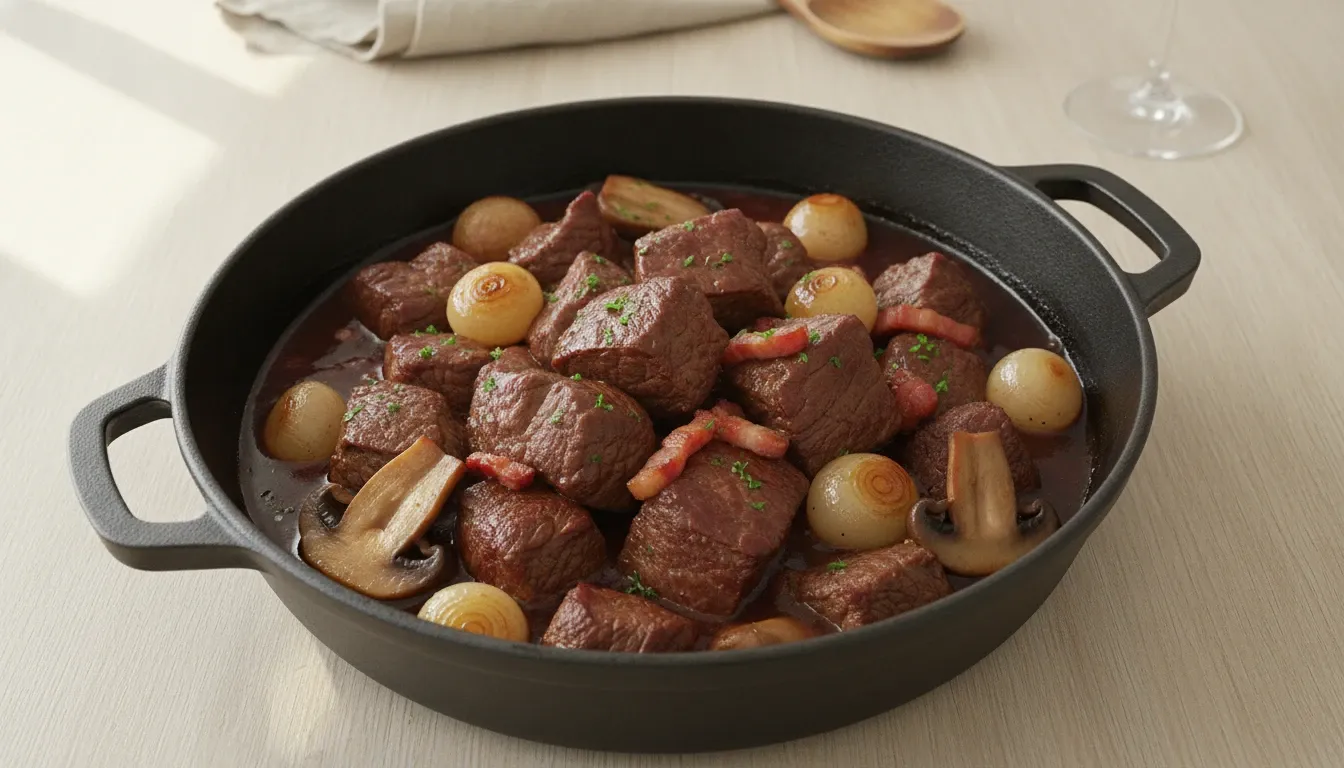
- Small onions, mushrooms, and bacon at 4:2:1 by weight, cooked in red wine
- Brunoise vs. macédoine
- Brunoise is a 2 mm dice, macédoine a 5 mm dice
- How to read a sauce name you don't know
- Find the base sauce and add one difference. Choron is béarnaise with tomato
A beef stew recipe says only “à la bourguignonne.” The onions are to be cut “en brunoise,” and the sauce on the side is “Choron.” None of them is explained.
French cooking terms are so specific because they were standardized over time, so that one name points to the same ingredients, sizes, and steps. Write “à la bourguignonne,” and the reader knows to add small onions, mushrooms, and bacon, and to cook it in red wine.
This article covers why French cooking gave names to its techniques, cuts, and recipes and standardized them. It also covers what reading a recipe’s names tells you in the kitchen.
The standard cut sizes and how to practice them are in French knife skills by level.
A French name covers ingredients, size, and method
What a name points to depends on the kind of name. Here are five kinds you meet in recipes, and what each one tells you in a single word.
| Kind of name | Example | What that one word tells you |
|---|---|---|
| Cut | Brunoise | Cut into a 2 mm (under ⅛ in) dice |
| Cooking method | Poêlé | Cook through over fairly gentle heat, basting with melted butter |
| Sauce | Béarnaise | Reduce white wine and tarragon vinegar, then bind with egg yolks and butter |
| Garnish | À la bourguignonne | Add small onions, mushrooms, and bacon, and cook in red wine |
| Kitchen station | Saucier | The cook who makes fond (stock from meat and bones) and sauces |
Sources: sizes from French knife skills by level; the cooking method from this site’s article on French cooking techniques; sauce, garnish, and station from Le Guide Culinaire, 2nd edition.
Where many recipes would spell it out in a sentence, such as “chop the onion finely” or “braise in red wine and add small onions and mushrooms,” French cooking uses one word. The catch is that you cannot read it unless you know what that word points to.
Escoffier made one name mean one recipe
The names were standardized in Le Guide Culinaire, the cookbook by the chef Auguste Escoffier (1846–1935). It was first published in 1903 and holds about 5,000 recipes.
Same name, same ingredients and garnish
At the head of the soup chapter, Escoffier writes that soups of the same name, whatever their type, use exactly the same ingredients and garnish (the solids floated in the soup).
He goes on to say that this was the rule he set himself for the whole book. It was the only way to replace the confusion of names with a strict and logical order.
Shape and plating may change, ingredients may not
The garnish chapter makes the same case. The combination in a garnish stays fixed. Only its shape and plating may change, never its ingredients.
Quantities are given for 10 servings and scaled up or down, depending on whether the garnish goes with a large joint of beef or small steaks. With the same name, the combination and ratio of ingredients stay the same as the amount changes.
He set a foundation and left room for style
In the foreword, Escoffier says he made the book “less a book than a tool.” Each cook stays free to develop a personal method. The book sets down only the traditional forms that work rests on.
In the preface to the 2nd edition, he adds that recipes once left to experience were brought under a method and a precision that leave nothing to chance. A name is the heading that calls up that foundation in a word.
Shared names make one-word kitchen orders work
When one name always means the same dish, every cook turns out the same plate. That is what made the large hotel kitchen work, with cooks split into stations: the brigade.
Orders are called out by name, then split by station
The appendix to Le Guide Culinaire shows how work is divided in a large kitchen.
When an order comes in, the cook in charge calls out the dish names. Each station head (chef de partie) writes down the items for that station.
The station that manages ingredients (garde-manger) gets a list of every order that day. Even if a station forgets to ask, the garde-manger reads the dish names and sends up the ingredients.
Escoffier writes that this lets a kitchen of 60 cooks serve orders for 400–500 guests in 1 hour to 1½ hours.
The national diploma still tests techniques by name
France’s national diploma for cooks, the CAP cuisine (certificate of professional competence), lists the minimum techniques a cook must master by their names. Here are some from the list in the current standard (the 2016 decree).
| Section of the list | Names listed (excerpt) |
|---|---|
| Cutting vegetables | Mirepoix, brunoise, paysanne, julienne, macédoine |
| Basic prep | Ciseler (chop finely), tourner (trim into a neat, faceted shape) |
| Cooking | Sauter, sauter and déglacer (dissolve the browned juices in the pan), pocher (poach) |
| Fonds and sauces | Make a fumet (fish stock), sauces bound with egg yolk or butter |
Source: CAP cuisine Annexe VI, the list of techniques to master.
The list gives no sizes or steps. It assumes that the name alone tells both candidate and examiner what the technique is.
What recipe names tell you in the kitchen
When a name always means the same contents, a single word in a home recipe tells you the ingredients, ratios, and sizes.
Garnish names give ingredients and ratios
À la bourguignonne (Burgundy style) is given in the original for 10 servings. It is 500 g of glazed small onions, 250 g of mushrooms quartered and sautéed in butter, and 125 g of browned bacon. That is 4:2:1 by weight.
The cooking liquid must be a good red wine, and the original calls this the “absolute characteristic” of à la bourguignonne. For 4 servings, use 200 g of small onions, 100 g of mushrooms, and 50 g of bacon.
Cook it in white wine instead of red, and it is not à la bourguignonne, even with the same garnish. How much red wine to add, and how far to reduce it before braising, is in cooking with wine in French cuisine.
Cut names fix sizes that cook evenly
Brunoise is a 2 mm (under ⅛ in) dice, and macédoine a 5 mm (¼ in) dice.
The same name means the same size, so the pieces cook through in the same time in the same pot. When a recipe names two different cuts, read it as two ingredients cooked for different times.
Mirepoix is the exception. It names a mix of aromatic vegetables such as carrot, onion, and celery, not a size. The original also says its fineness depends on its use. The longer a dish cooks, the larger you cut it.
Derived names add one change to a base
Most sauce names are a base sauce with one change. The original writes each derived sauce by referring to the name of its base.
| Name | Base | What is added or swapped |
|---|---|---|
| Béarnaise | (the base) | Reduce white wine and tarragon vinegar, then bind with egg yolks and butter |
| Choron | Béarnaise | Leave out the finishing herbs and add thick tomato purée, a quarter of the sauce’s volume |
| Foyot (Valois) | Béarnaise | Add melted meat glaze (glace de viande) |
| Paloise | Béarnaise | Replace the tarragon with the same amount of mint |
Source: the sauce chapter of Le Guide Culinaire, 2nd edition. Quantities and method for béarnaise are in this site’s article on the role of sauces in French cooking.
When you meet a sauce name you don’t know, find its base sauce and add the one change. Then you can make it.
Japanese and Chinese cooks name different things
Every cuisine names the methods it uses most. What differs is what gets named.
| Cuisine | What has names | Examples |
|---|---|---|
| French | Cuts, cooking methods, sauces, garnishes, kitchen stations | Brunoise 2 mm, à la bourguignonne, Choron, saucier |
| Japanese | Ratios of mixed seasoning liquids | Happo dashi (dashi 8 : soy sauce 1 : mirin 1) as the base, varied into salt and sake versions |
| Chinese | Cut sizes | Ding (dice) 8–10 mm (about ⅜ in), si (shreds) 2 mm wide |
Sources: this site’s articles on Japanese seasoning liquids (ji) and on why Japanese cooking puts cutting first. For more on the cuts, see dice cuts compared and julienne vs. sengiri vs. Chinese si.
Happo dashi is an all-purpose Japanese seasoning liquid. It mixes dashi, the Japanese stock of kelp and dried bonito, with soy sauce and mirin, a sweet rice wine for cooking.
French cooking named the combinations of ingredients on the plate, and even the division of labor in the kitchen, and gathered it all in one book. That is why one word in a French recipe can stand in for steps a Japanese recipe would write out in several lines.
Conditions that make it work
Here is how to read a name when you meet one in a home recipe.
| When | What to do | Why |
|---|---|---|
| A sauce name you don’t know | Find the base sauce in the name and add just one change | Derived sauces are written as a base plus one change |
| Only a garnish name is given | Keep the ratio of ingredients and scale the amount to the number of people | The name fixes the combination and ratio, not the amount |
| The recipe names two cuts | Cook each named cut for its own time | Different sizes take different times to cook through |
| You lack an ingredient the name calls for | Make it without the name. Beef braised in white wine is just “braised in white wine” | Otherwise the name and what is on the plate disagree |
Common failures and fixes
Underdone dice and a runny sauce can be fully fixed. Vegetables that fell apart can only be partly saved.
| Problem | Cause | Fix it now | Prevent it next time |
|---|---|---|---|
| Some pieces are still hard | A 2 mm dice and a 5 mm dice went into the same pot together. Heat takes longer to reach the center of larger pieces, so the 5 mm dice stayed hard inside | Lift out only the larger pieces and parboil them again, or cut them down to 2 mm and return them to the pot | In any one pot, use vegetables cut the same named way |
| The vegetables fell apart | Aromatic vegetables for a braise of over 2 hours were cut to 2 mm. They softened early and kept cooking, until their structure broke down | Strain the liquid to remove the broken-down vegetables. Cut fresh aromatics larger, sauté them in butter, and add them back as garnish | The longer the braise, the larger you cut the aromatics. Mirepoix is not a size, so change how fine you cut it to suit the dish |
| The sauce is runny | Unreduced tomato went in. Water collected between the fat droplets of butter held by the egg yolk, thinning the sauce until it ran | Reduce the tomato in a separate small pan until a line drawn across the bottom with a wooden spoon stays open, then add it again | Use tomato concentrate or well-reduced tomato, a quarter of the sauce’s volume |
Four things to know when reading names
French cooking terms are specific not because there are so many words to learn, but because each word holds so much.
- The same name means the same combination and ratio of ingredients. Only the amount and plating change
- In the kitchen, calling out a dish name is enough for each station to prepare its part
- Cut names point to sizes; garnish names point to ingredients and their ratios
- Read an unknown sauce name as a base sauce plus one change
Follow the name, and even a dish you have never made starts from the same ingredients and ratios as Escoffier’s kitchen.
Sources
- Escoffier, A. Le Guide Culinaire, aide-mémoire de cuisine pratique (first edition 1903; quoted from the 2nd edition, Émile Colin). The foreword (Avant-Propos), the preface to the 2nd edition, the introductions to the soup and garnish chapters, and the appendix on dividing work in a large brigade (in French)
- Escoffier, A. A Guide to Modern Cookery. Heinemann, 1907 (English translation; recipes numbered 1 to 2973)
- French Ministry of National Education. CAP Cuisine, Annexe VI: Liste des techniques professionnelles à maîtriser (annex to the decree of March 17, 2016) (in French)