What this article answers
- How thick each style slices
- Sogi-giri 3–5 mm, émincé and pian 2–3 mm. The thinnest cuts go down to 1 mm or less
- What angle to hold the knife at
- 30–45° for sogi-giri and pian, about 45° for émincé. Ping dao pian lays the blade almost flat, at 10–20°
- How to slice meat paper-thin
- Half-freeze it for 30–40 minutes, until it feels a little firm but the knife still goes in
- Which style to learn first
- Sogi-giri on chicken breast. It teaches you to read the fibers, which the other two build on
Cooks all over the world slice food thin at an angle. But the angle, the thickness, and the reason change from one cuisine to the next.
This article compares three of these cuts: Japanese sogi-giri, French émincé, and Chinese pian. It looks at what each is for, how it is cut, and how it treats the grain.
Three slicing styles side by side
| Japanese sogi-giri | French émincé | Chinese pian | |
|---|---|---|---|
| Aim | Cut the fibers short for tenderness | Thin slices that cook quickly | Even, fast cooking over high heat |
| Standard thickness | 3–5 mm (flexible) | 2–3 mm (even) | 2–3 mm (as thin as possible) |
| Knife angle | 30–45° | About 45° | 30–45° (ping dao pian almost flat) |
| Grain direction | Cutting the fibers comes first | Secondary | Depends on the dish |
| Knife motion | Pull cut | Slicing motion | Pull cut (la dao pian) |
| What matters most | Tenderness, ease of eating | Even thickness, speed | Thinness, speed, even cooking |
| Knife | Yanagiba (sashimi knife), gyuto (chef’s knife) | Chef’s knife | Chinese slicing cleaver (wen dao) |
| Main uses | Chicken breast, white fish, negi (Japanese long onion) | Onions, mushrooms, meat | Pork, beef, fish |
For scale, 1 mm is under 1/16 in, 2–3 mm is about 1/16–⅛ in, and 3–5 mm is about ⅛–3/16 in.
Japanese sogi-giri cuts the fibers short
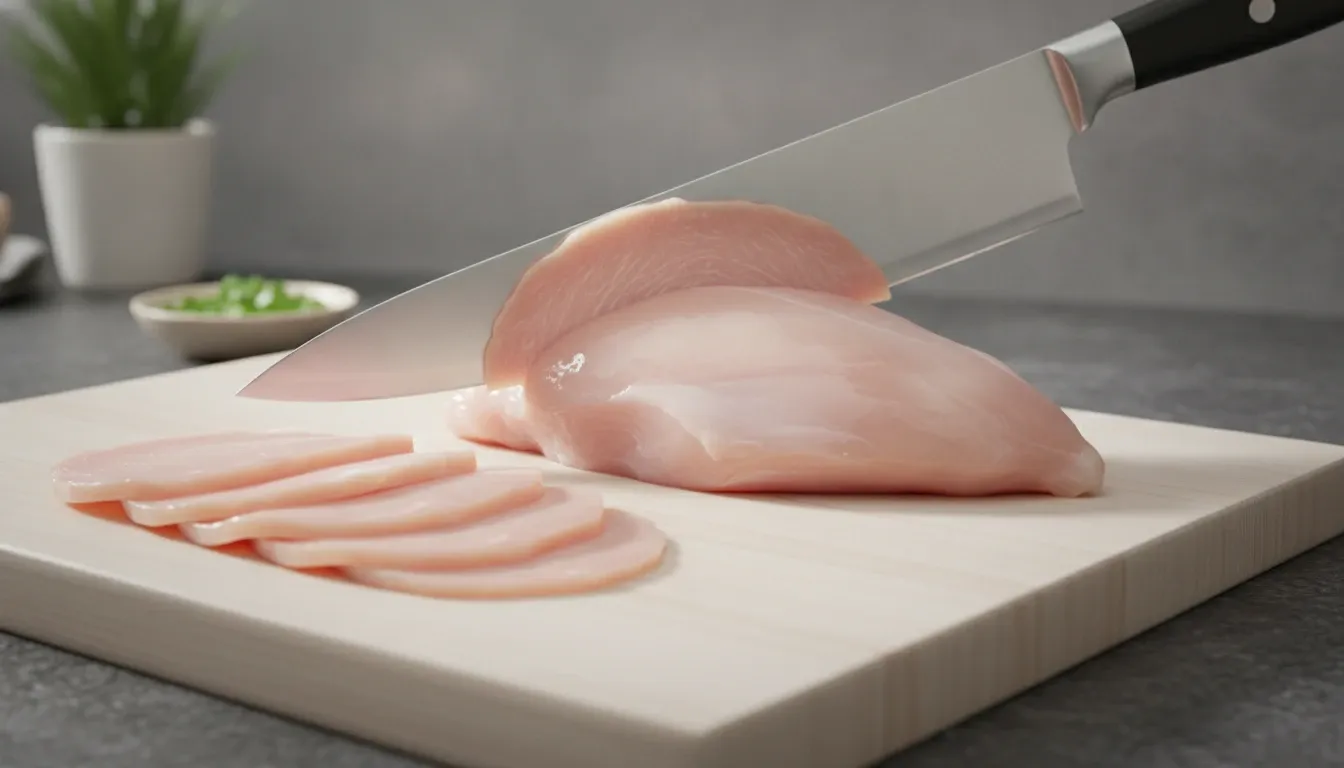
Sogi-giri puts one goal first: cutting through the fibers to make food tender. It does the most for ingredients with strong fibers, such as chicken breast.
Size and angle
| Standard | Extra-thin (sashimi) | |
|---|---|---|
| Thickness | 3–5 mm | 2–3 mm |
| Angle | 30–45° | About 30° |
| Cut surface | 1.5–2× the original | 2–3× the original |
Why cut at an angle
An angled cut does three things:
- It enlarges the cut surface, so heat gets in faster.
- It crosses more fibers than a straight cut does.
- It leaves the fibers shorter, so the slice is easy to bite through and tender.
How the knife moves
- Pull cut: draw the knife toward you as it cuts, so the meat fibers aren’t crushed.
- One stroke: cut each slice free in a single pull, without sawing back and forth.
- The yanagiba’s long blade lets you finish each slice in one pull. A gyuto works too.
Reading the grain on chicken breast
Steps for sogi-giri on chicken breast:
- Lay the breast skin side down.
- Find the direction of the fibers. They run at a slant.
- Set the knife at an angle that crosses the fibers, close to a right angle to them.
- Tilt the blade down to 30–45° and pull it toward you as you cut.
Where it’s used
| Dish | Ingredient | Grain | Result |
|---|---|---|---|
| Sautéed chicken breast | Chicken breast | Across | Breast meat, which dries out easily, stays tender |
| White-fish sashimi | Sea bream, flounder | Across | Tender enough to come apart in the mouth |
| Sliced negi | White part of negi | Across | The fibers of the white part are cut, so it is easy to eat |
| Pork shabu-shabu (thin pork swished in simmering broth) | Pork | Across | Thin slices cook through in moments |
Tips from professionals
- Half-freeze the meat: 30–40 minutes in the freezer, not frozen solid. It slices thin more easily.
- Lay the knife down to about 30°. If the angle is too steep, you get an ordinary slice.
- Always pull. Pushing crushes the meat and breaks up the fibers.
- Chicken breast fibers run at a slant. Holding the meat to the light makes them easier to see.
French émincé aims for even thickness
Émincé means thin slices of even thickness, cut so they cook quickly. It is used on a wide range of ingredients, from onions and mushrooms to meat.
Size and angle
| Standard | Extra-thin (raw dishes) | |
|---|---|---|
| Thickness | 2–3 mm | 1 mm or less |
| Angle | About 45° (depends on the ingredient) | About 30° |
| Evenness | ±0.5 mm | ±0.3 mm |
The slicing motion
Move the knife forward and back as it cuts:
- Push the knife away from you as it comes down.
- Or draw it toward you as it comes down.
- Use the whole length of the blade, in one smooth stroke.
Onions and mushrooms
Onion émincé:
- Halve the onion.
- Leaving the root end on, cut into it radially, along the fibers.
- Slice thin, straight down, along the fibers.
- The slices keep their shape even when cooked.
Mushroom émincé:
- Stand the mushroom upright.
- Slice from cap to stem, so each slice is T-shaped.
- Cut 2–3 mm thick.
- Fine restaurants slice them 1 mm or thinner.
Why evenness matters
- Even cooking: slices of one thickness cook through in the same time.
- The sauce coats every slice evenly.
- The professional standard is within ±0.5 mm.
Where it’s used
| Dish | Ingredient | Result |
|---|---|---|
| French onion soup | Onion | Sliced along the fibers, it keeps its shape through long cooking |
| Sautéed mushrooms | Mushrooms | Even thickness, so they cook evenly |
| Émincé de veau | Veal | Sliced thin and sautéed, it cooks in moments |
| Carpaccio | Beef, fish | Sliced paper-thin and eaten raw |
Tips from professionals
- Use a well-sharpened knife. A dull one crushes the food.
- Move the knife forward and back. Pressing straight down won’t cut cleanly.
- Use a pinch grip: pinch the base of the blade between thumb and index finger for fine control.
- A professional slices one onion into émincé in under 3 minutes.
Chinese pian slices thin for fast cooking
Pian slices food very thin so it cooks almost instantly over high heat. For shuan yang rou (涮羊肉), a lamb hot pot, the meat must be paper-thin.
Size and angle
| Standard | Extra-thin (shuan yang rou) | |
|---|---|---|
| Thickness | 2–3 mm | 1 mm or less (see-through) |
| Angle | 30–45° | About 30° |
| Knife | Wen dao (thin slicing cleaver) | Wen dao, well sharpened |
Three kinds of pian
| Name | Pinyin | What it does | Angle |
|---|---|---|---|
| 平刀片 | ping dao pian | Slices with the blade laid almost flat | 10–20° |
| 斜刀片 | xie dao pian | Slices with the blade at a slant | 30–45° |
| 反刀片 | fan dao pian | Slices at a slant from the opposite side | 30–45° |
Slicing almost flat (ping dao pian)
- Used to split a thick piece of meat into two thin ones.
- Lay the knife down to 10–20°, hold the food flat with your other hand, and cut horizontally.
- It takes real skill and is dangerous for beginners.
Slicing at a slant (xie dao pian)
- The standard angled slice: the knife enters at 30–45°.
- The most common kind of pian.
- It enlarges the cut surface, so heat gets in faster.
Half-freezing for paper-thin slices
For the paper-thin lamb of shuan yang rou:
- Put the lamb (or pork, or beef) in the freezer for 30–40 minutes.
- Don’t let it freeze solid; you want it half-frozen.
- Lay the knife down to about 30°.
- Pull it toward you, slicing thin enough to see through (1 mm or less).
Where it’s used
| Dish | Ingredient | Thickness | Result |
|---|---|---|---|
| Shuan yang rou (lamb hot pot) | Lamb, beef | 1 mm or less | See-through. A few seconds in boiling broth is enough |
| Hui guo rou (twice-cooked pork) | Pork | 2–3 mm | Thin slices, cooked fast over high heat |
| Shui zhu yu pian (Sichuan poached fish) | Fish | 3–5 mm | Fish fillet sliced at an angle |
| Qing jiao chao rou pian (pork with green peppers) | Pork | 2–3 mm | Stir-fried with green peppers |
Tips from professionals
- Half-freezing: 30–40 minutes in the freezer. Press with a finger: it should feel a little firm, but the knife should still go in.
- Use a wen dao, the thin slicing cleaver. A wu dao (heavy chopping cleaver) won’t slice thin.
- Pull cut (la dao pian): draw the knife toward you so the meat fibers aren’t crushed.
- Cut pork and beef across the fibers to make them tender.
How the three compare
Thickness and angle
| Cuisine | Standard thickness | Angle | Extra-thin | Thinness |
|---|---|---|---|---|
| Japanese (sogi-giri) | 3–5 mm | 30–45° | 2–3 mm (sashimi) | Middle |
| French (émincé) | 2–3 mm | About 45° | 1 mm or less (carpaccio) | Middle |
| Chinese (pian) | 2–3 mm | 30–45° | 1 mm or less (shuan yang rou) | Thinnest |
Chinese pian is the thinnest because of short, high-heat cooking: shuan yang rou cooks through in seconds. Japanese sogi-giri is a little thicker because it cuts the fibers first, balancing tenderness with something to bite. French émincé puts evenness first: every slice the same, so all of it cooks the same.
Grain direction
| Cuisine | Attention to grain | How the cut is chosen |
|---|---|---|
| Japanese | Very high | Cutting the fibers comes first. It is the main point of sogi-giri |
| French | Medium | Depends on the dish. Onions along the fibers, meat across them |
| Chinese | Medium | Depends on the dish. Across the fibers when you want tenderness |
Knife and technique
| Cuisine | Knife | Knife motion | Blade |
|---|---|---|---|
| Japanese | Yanagiba, gyuto | Pull cut (toward you) | Single or double bevel, long blade |
| French | Chef’s knife | Slicing motion (forward and back) | Double bevel, 20 cm (8 in) or longer |
| Chinese | Chinese slicing cleaver (wen dao) | Pull cut (la dao pian) | Thin blade, large but light |
Cooking method
| Cuisine | Main cooking methods | Why slice at an angle |
|---|---|---|
| Japanese | Grilling, simmering, raw | Cut the fibers so the food is tender and easy to eat |
| French | Sautéing, frying, raw | Even thickness, so it cooks quickly and evenly |
| Chinese | Stir-frying over high heat, hot pot | Slice very thin, so it cooks almost instantly |
One block of pork, three ways
The test
- Ingredient: 500 g of pork collar (shoulder butt) in one block
- Cut by: an intermediate-level cook
- Measured: time taken, thickness, texture, and the dishes each suits
Results
| Style | Time | Thickness | Grain | Texture (after cooking) | Best for |
|---|---|---|---|---|---|
| Sogi-giri (Japan) | 3 minutes | 4 mm | Across | Tender, juicy | Grilling, simmering |
| Émincé (France) | 4 minutes | 2.5 mm | Along | Firm bite | Sautéing, frying |
| Pian (China) | 5 minutes | 2 mm | Across | Tender, cooks quickly | Stir-frying over high heat |
What the test showed
- Speed: sogi-giri was fastest, because the slices are a little thicker.
- Thinness: pian was thinnest, using the half-freezing method.
- Tenderness: sogi-giri and pian were tender, because both cut across the fibers.
- Each style is tuned to a different way of cooking.
Which style to choose
| Ingredient and method | Style | Why |
|---|---|---|
| Chicken breast, grilled or pan-fried | Japanese sogi-giri | Cutting the fibers keeps it from drying out |
| Onion, sautéed | French émincé, along the fibers | Keeps its shape and turns sweet |
| Pork, stir-fried over high heat | Chinese pian | Thin slices cook almost instantly |
| White fish, as sashimi | Japanese sogi-giri | Cutting the fibers makes it come apart in the mouth |
| Beef, as carpaccio | French émincé, extra-thin | See-through slices with a delicate texture |
| Lamb, in hot pot | Chinese pian, extra-thin | Paper-thin, cooked in seconds |
| Negi, stir-fried | Japanese sogi-giri | Cutting the fibers lets heat in faster |
A practice plan for each style
Beginner (about 1–3 months)
Goal: learn the basic form of each style.
| Weeks | Practice | Pass mark |
|---|---|---|
| 1–4 | Sogi-giri (chicken breast) | 4–5 mm thick, within ±1 mm; one breast in 3 minutes or less |
| 5–8 | Émincé (onion) | 2–3 mm thick, within ±0.5 mm; one onion in 3 minutes or less |
| 9–12 | Pian (pork) | 2–3 mm thick, within ±1 mm; 200 g of pork in 3 minutes or less |
Intermediate (about 3–6 months)
Goal: precision and speed together.
| Weeks | Practice | Pass mark |
|---|---|---|
| 1–8 | Sogi-giri (reading the grain) | Fibers reliably cut, 3–4 mm thick |
| 9–16 | Extra-thin émincé | 1–2 mm thick, on mushrooms or truffles |
| 17–24 | Ping dao pian | Knife laid flat, splitting a thick piece of meat in two |
Advanced (about 6 months to 1 year)
Goal: use every style at will.
- Sogi-giri for sashimi: 2–3 mm, thin enough to see light through.
- Émincé for carpaccio: 1 mm or less, see-through.
- Pian for shuan yang rou: 1 mm or less, paper-thin.
- Creative use: design a dish that uses all three styles.
Combining all three on one plate
A three-way pork plate
The idea: cut the same pork three ways, and enjoy how texture and cooking change with the cut.
- Sogi-giri (Japan): 4 mm, across the fibers. Grilled teriyaki-style. Tender and juicy.
- Émincé (France): 2.5 mm, along the fibers. Sautéed with a mustard sauce. A firm bite.
- Pian (China): 2 mm, across the fibers. Stir-fried over high heat and seasoned with tianmianjiang (sweet bean sauce). Tender and toasty.
The sauces:
- Japanese: teriyaki sauce
- French: whole-grain mustard sauce
- Chinese: tianmianjiang and doubanjiang (chili bean paste)
What the plate shows:
- Three different textures on one plate.
- Each cut paired with the cooking that suits it.
- The same ingredient becomes three different dishes, depending on the cut.
Common questions
Which style should I learn first?
Start with Japanese sogi-giri, for three reasons:
- It teaches you to read the fibers, which the other styles build on.
- You can practice on chicken breast, which is cheap and easy to find.
- You can taste the effect: dry chicken breast turns tender.
Once it feels natural, learn French émincé (evenness) and then Chinese pian (paper-thin slices). In that order, the point of each style is easiest to see.
How do sogi-giri and émincé differ?
They differ in aim and in what they care about most.
| Sogi-giri | Émincé | |
|---|---|---|
| Main aim | Cut the fibers for tenderness | Even thickness for quick cooking |
| Grain | Cutting the fibers comes first | Chosen for the dish |
| Thickness | 3–5 mm (flexible) | 2–3 mm (even) |
| What precision means | Cutting the fibers | Evenness |
Both slice thin at an angle, but they start from different ideas.
Why does Chinese pian slice so thin?
Because it is built for short, fierce cooking over high heat (bao chao):
- Shuan yang rou cooks through after a few seconds in boiling broth, because it is 1 mm or less.
- In a high-heat stir-fry, thin slices also cook almost instantly.
- The thinner the slice, the sooner it cooks through, before the meat toughens.
How do I learn the knife angle?
Mostly through practice, but a few tricks help:
- At first, stick masking tape on the spine of the knife to show a 30° angle.
- Tilt the knife to 30° against the board, and let your body learn the angle.
- Practice in front of a mirror and check the angle from the side.
- With time, you will tilt to 30° by feel.
How long should I half-freeze the meat?
About 30–40 minutes in the freezer, adjusted for these factors:
| Factor | Adjustment |
|---|---|
| Thickness of the meat | Thicker takes longer (block: 40 minutes; thin cuts: 20 minutes) |
| Freezer temperature | Colder takes less time |
| Kind of meat | Fattier takes longer (it freezes less readily) |
You want it to feel a little firm when pressed with a finger, but still let the knife in. Don’t freeze it solid.
Choose the style by its purpose
Even a single technique, slicing at an angle, carries each cuisine’s way of thinking:
- Japanese sogi-giri: cut the fibers so the food is tender and easy to eat.
- French émincé: even thickness, for quick and efficient cooking.
- Chinese pian: slice very thin and cook almost instantly over high heat.
What to take from this:
- Know the purpose: why slice at an angle, and why at that angle.
- Watch the grain: understand which way the fibers run, and choose the cut from that.
- Learn the angle: get 30–45° into your hands.
- Use them creatively: combine the three styles to create new dishes.
For other cuts compared across cuisines, see Julienne vs. Sengiri vs. Chinese Si and Dice Compared Across Cuisines. For how knife skills build in each cuisine, see the level guides for Japanese, French, and Chinese knife work.
Sources
- Kyodo Kumiai Keihin Hamono Senmonten-kai (Keihin cutlery retailers' cooperative). "Types of kitchen knives" (in Japanese). Japanese, Western, and Chinese knives and what each is for
- Sakai Ichimonji Mitsuhide. "Japanese knives and Western knives: what is the difference?" (in Japanese). Single and double bevels, and how the steel changes sharpness
- Tsuji Culinary Institute (in Japanese). Techniques and cooking theory of each cuisine