What this article answers
- What to learn first in Chinese cooking
- The cleaver and wok, basic cuts such as si, pian and ding, prep work, and the core seasonings
- How long each level takes in a kitchen
- 0–6 months as an apprentice, 2–5 years to run a station, 8 years or more to head a kitchen
- Which skill matters most
- Heat control. A Chinese saying holds that if the heat isn't right, all the work is wasted
- When thickening (gou qian) and decorative cuts come in
- Level 4, after the basic and applied cooking methods
This skill map lays out Chinese cooking technique by level. It runs from a first-day apprentice to a head chef, in the order the skills are learned.
How the five levels are defined
| Level | Rank | Skills | Chinese kitchen title | Typical experience |
|---|---|---|---|---|
| Level 1: Apprentice | Beginner | Handles the Chinese cleaver and wok. Cuts the basic shapes (si, pian, ding). Does prep: washing, peeling, marinating | Xue tu, xiao gong | 0–6 months |
| Level 2: Station member | Beginner to intermediate | Stir-fries, steams and deep-fries. Understands how to make stock. Par-cooks food briefly in warm oil or water. Cooks single dishes as instructed | Zhong gong | 6 months–2 years |
| Level 3: Station chef | Intermediate | Roasts, braises, dresses and sauce-fries. Controls heat at will. Handles part of a banquet. Teaches juniors | Da gong, ling ban | 2–5 years |
| Level 4: Sous chef | Advanced | Masters decorative cuts. Thickens sauces perfectly. Coordinates a whole banquet. Runs the kitchen and quality control | Er chu, fu chu shi zhang | 5–8 years |
| Level 5: Head chef | Master | Balances color, aroma, taste and shape. Understands and reproduces regional styles. Balances tradition and change. Writes menus and trains successors | Tou chu, chu shi zhang | 8 years or more |
Level 1 builds the foundation
1.1 Cookware basics
Difficulty: 1 of 5.
What you need to know:
- The types of Chinese cleaver and what each is for, such as the cai dao (all-purpose) and pian dao (slicing)
- Types and sizes of wok
- How to use the wok ladle and the wok spatula
- Types of steamer, bamboo or metal
- How to choose a cutting board
Skills to practice:
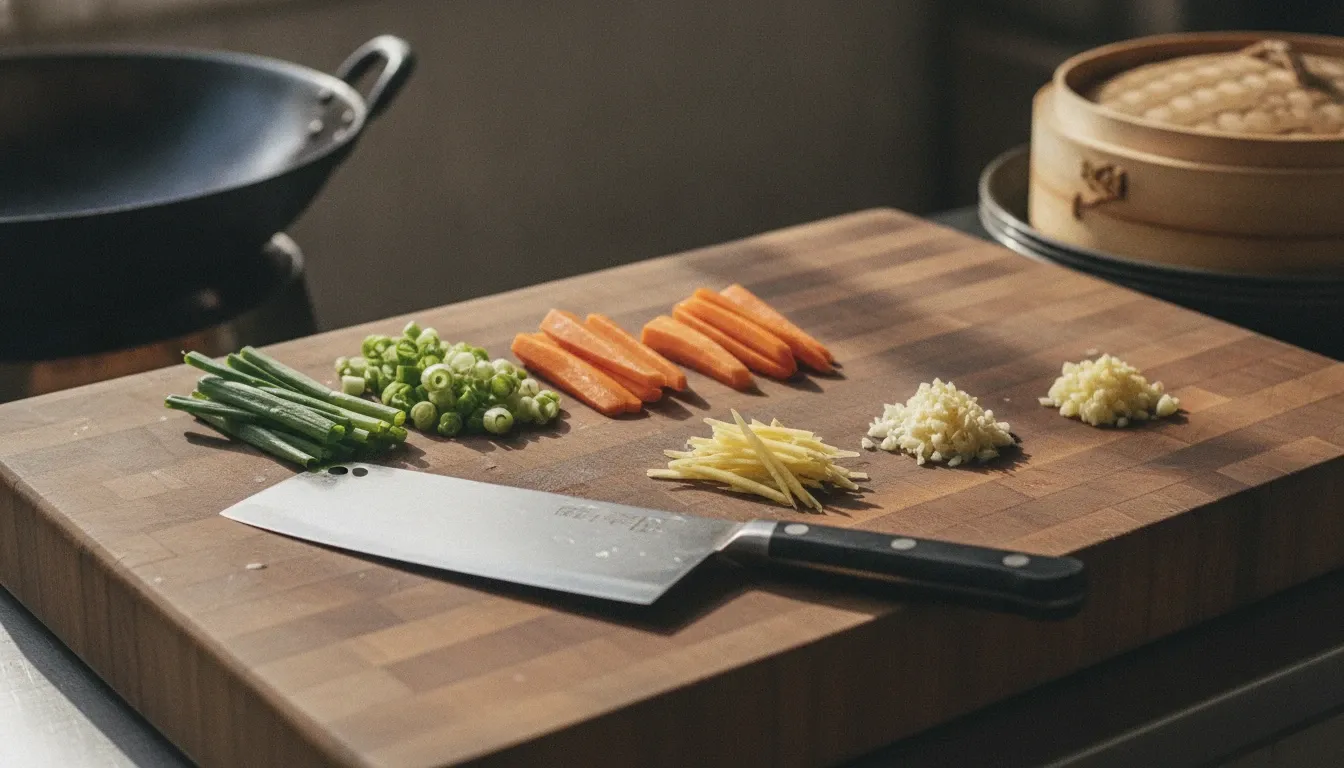
- Holding the cleaver and the basic cuts
- The basics of tossing the wok
- Sharpening the cleaver
- Caring for your cookware
- Adjusting the heat: high, medium, low
1.2 Handling basic ingredients
Difficulty: 1 of 5.
What you need to know:
- How to wash and store vegetables
- Meat cuts and their character, mainly pork and chicken
- How to judge the freshness of fish and shellfish
- How to rehydrate dried goods, such as dried shiitake and wood ear mushrooms
- Basic prep methods
Skills to practice:
- Peeling and washing vegetables
- Trimming sinew from meat and marinating it
- Scaling and gutting fish
- Rehydrating and storing dried goods
- Cutting ingredients to an even size
1.3 Basic knife cuts
Difficulty: 2 of 5.
Chinese cooks call knife work dao gong. The basic shapes each have a name.
What you need to know:
- The names of the basic cuts, such as si, pian, ding, mo and kuai
- Which cut suits which ingredient
- How the cut relates to the cooking method
- How the cut changes how fast food cooks through
Skills to practice:
- Si: fine shreds
- Pian: thin slices
- Ding: dice
- Mo: a fine mince
- Kuai: large chunks
- Gun dao kuai: roll-cut chunks, cut at an angle while turning the ingredient
For each shape’s size and a test to measure your own cuts, see Chinese Knife Skills by Level.
1.4 Basic seasonings
Difficulty: 1 of 5.
What you need to know:
- The basic seasonings: salt, soy sauce, vinegar, sugar, fermented bean pastes
- Types of fat: neutral vegetable oil, sesame oil, lard
- Rice wines: Shaoxing wine and Chinese cooking wine (liaojiu)
- The aromatics: scallion, ginger, garlic
- The basic spices, such as star anise, Sichuan pepper and cassia
Skills to practice:
- Choosing the right seasoning
- Cutting the aromatics
- Managing oil temperature
- Tasting and adjusting
- Marinating
Level 2 adds stocks and core methods
2.1 Stock basics
Difficulty: 2 of 5.
In Chinese cooking, tang means stock or soup.
What you need to know:
- Types of stock, such as clear stock (qing tang), milky white stock (bai tang) and everyday stock (gao tang)
- How first-grade and second-grade stock differ
- How to store stock
- Skimming, and keeping stock from turning cloudy
Skills to practice:
- Making chicken stock
- Making pork bone stock
- Making a clear stock
- Making a milky white stock
- Finishing a top-grade stock (shang tang)
The grades of stock (mao tang, qing tang, shang tang) and how to make white stock are explained in Chinese Stock Types.
2.2 Stir-frying basics
Difficulty: 3 of 5.
What you need to know:
- Types of stir-fry, such as raw stir-fry (sheng chao), stir-frying precooked food (shu chao), smooth stir-fry (hua chao) and blast-frying (bao chao)
- How heat and stir-frying time relate
- How to pass food through oil (guo you), a brief par-cook in warm oil before the stir-fry
- How to toss the wok
Skills to practice:
- Sheng chao: the basic vegetable stir-fry
- Hua chao: stir-frying meat so it stays smooth
- Bao chao: cooking hard and fast over high heat
- Mastering the wok toss
- Managing oil temperature when passing food through oil
2.3 Steaming basics
Difficulty: 2 of 5.
What you need to know:
- Types of steaming, such as plain steaming (qing zheng), steaming in a rice-flour coating (fen zheng) and steaming in a bowl then turning out (kou zheng)
- Steaming time and heat
- How to use a steamer
- Managing the water
Skills to practice:
- Qing zheng: steamed fish
- Zheng dan: steamed egg custard
- Steaming buns
- Judging steaming time
- Managing the water in the steamer
2.4 Deep-frying basics
Difficulty: 2 of 5.
What you need to know:
- Types of deep-frying, such as frying bare (qing zha), frying crisp (gan zha) and frying in a soft batter (ruan zha)
- Managing oil temperature on the cheng scale, where Chinese cooks count oil heat in tenths (3, 5, 7 cheng and so on)
- Types of batter and coating, and when to use each
- How to double-fry
Skills to practice:
- Qing zha: frying with no coating
- Gan zha: frying until dry and crisp
- Ruan zha: frying in a batter for a soft finish
- Judging oil temperature by holding a hand above it, or with a wooden chopstick
- Judging when the food is done
Level 3 adds braising, dressing and curing
3.1 Roasting and pan-frying
Difficulty: 3 of 5.
What you need to know:
- How roasting (shao) and pan-frying (jian) differ
- Types of roasting, such as over open fire, in a closed oven, and char siu
- Heat for pan-frying
- How to brown food
Skills to practice:
- Jian: pan-frying, as for pot-stickers
- Char siu: Cantonese roast pork
- Peking duck: the basics
- Judging doneness
- Controlling browning and roasted aroma
3.2 Braising
Difficulty: 3 of 5.
What you need to know:
- How shao (braising) and hui (braising in a thickened sauce) differ
- Red braising (hong shao), with soy sauce
- White braising (bai shao), without soy sauce
- Types of hui, such as red and white
Skills to practice:
- Hong shao rou: red-braised pork belly
- Bai shao: a pale braise
- Hui: a braise finished with thickened sauce
- Managing braising time
- Thickening the sauce
3.3 Dressing and sauce-frying
Difficulty: 3 of 5.
Ban means to dress or toss, and liu means to cook food and then coat it in a thickened sauce.
What you need to know:
- Types of dressed dishes
- Liang ban: cold dressed dishes
- How liu works: cook the food, then finish it in a sauce
- How to make dressings and sauces
Skills to practice:
- Liang ban: cold dressed dishes
- Ban mian: tossing noodles in sauce
- Liu: frying, then thickening with sauce
- Mixing a sauce to a ratio
- Adjusting how much dressing to use
3.4 Pickling and curing
Difficulty: 3 of 5.
What you need to know:
- Types of pickles (yan)
- Curing and smoking (la)
- Managing fermentation
- Storage
Skills to practice:
- Yan cai: pickled vegetables
- La rou: cured pork belly and sausages
- Salted eggs and century eggs
- Managing pickling time
- Controlling fermentation
Level 4 refines knife, heat and thickening
4.1 Advanced knife skills
Difficulty: 4 of 5.
Hua dao (花刀) means scoring decorative patterns into the surface of an ingredient.
What you need to know:
- Types of hua dao
- The wheat-ear pattern (mai sui hua dao)
- The chrysanthemum pattern (ju hua hua dao)
- The lychee pattern (li zhi hua dao)
- How the cut relates to texture
Skills to practice:
- Complex decorative cuts
- Even slices, as thin as paper
- Hair-thin shreds (fa si)
- Carving-style cuts
- Controlling texture through the cut
To compare these with decorative cuts from other cuisines, see Decorative Cutting Across Cuisines.
4.2 Advanced heat control
Difficulty: 4 of 5.
Chinese cooks call heat control huo hou (火候).
What you need to know:
- Heat control in detail
- When to use fierce heat (wu huo) and gentle heat (wen huo)
- Using residual heat
- Combining several heat levels
Skills to practice:
- Bao chao: a flash stir-fry over intense heat
- Slow simmering over low heat
- Fast stir-frying over high heat
- Judging the heat in an instant
- Combining heat levels in one dish
4.3 Thickening with gou qian
Difficulty: 4 of 5.
Gou qian (勾芡) is thickening a sauce with a starch slurry.
What you need to know:
- Types of gou qian, such as bao qian, hu qian and liu qian
- How to mix the slurry (qian zhi)
- Why timing matters
- How thickness relates to the dish
Skills to practice:
- Bao qian: a thickening that wraps the food
- Hu qian: a heavy thickening
- Liu qian: a light, flowing thickening
- Timing the slurry
- Adjusting the thickness
4.4 Banquet cooking
Difficulty: 4 of 5.
What you need to know:
- How a banquet is built: cold dishes, hot dishes, soup, dim sum, fruit
- Arranging cold platters (pin pan)
- Cooking large shared platters
- Controlling timing
Skills to practice:
- Pin pan: arranging cold platters beautifully
- Da cai: cooking the main dishes
- Tang cai: finishing soup dishes
- Cooking several dishes at once
- Coordinating the whole banquet
Level 5 is mastery and regional style
5.1 The aesthetics of Chinese cooking
Difficulty: 5 of 5.
What you need to know:
- The balance of color, aroma, taste and shape
- The thinking of yin-yang and the five phases
- The idea that food is medicine
- Seasons and ingredients
- Regional character
Skills to practice:
- Building a menu (cai dan)
- Arranging color
- Layering aromas
- Composing shapes
- Considering nutritional balance
How these ideas compare with Japanese and French cooking is covered in Chinese Cuisine vs. Japanese and French.
5.2 The four and eight great cuisines
Difficulty: 5 of 5.
What you need to know:
- The four great cuisines: Beijing (jing cai), Shanghai (hu cai), Cantonese (yue cai) and Sichuan (chuan cai)
- The eight great cuisines: the four above plus four of Shandong (lu cai), Huaiyang, Zhejiang, Fujian (min cai), Hunan (xiang cai) and Anhui (hui cai)
- The traits and techniques of each region
- How each region uses seasonings
- The history and background of regional dishes
There are different schools of classification. Some count the four great cuisines as Shandong, Sichuan, Cantonese and Huaiyang.
Skills to practice:
- Reproducing regional dishes
- Understanding regional seasoning
- Using regional ingredients
- Reinterpreting regional dishes for today
- Combining several regional styles
5.3 Creative Chinese cooking
Difficulty: 5 of 5.
What you need to know:
- Innovation grounded in traditional technique
- Blending in techniques from other cuisines
- Bringing in modern ingredients
- A style of your own
Skills to practice:
- Reinterpreting traditional techniques
- Introducing new ingredients and techniques
- Building a menu of your own
- Telling a story through a dish
- Balancing tradition and change
5.4 The cook’s mindset
Difficulty: 5 of 5.
What you need to know:
- The way of the cook (chu shi zhi dao)
- Respect for ingredients
- The master-apprentice system
- Passing on tradition while changing it
Skills to practice:
- Always keep learning
- Listening to the ingredients
- Managing a team
- Balancing tradition and change
- Training those who come after you
What to keep in mind while learning
Why heat control matters most
In Chinese cooking, heat control is one of the most important skills. A saying puts it this way: if the heat isn’t right, all the effort is wasted (huo hou bu dao, gong fu bai fei). Mastering heat is the heart of Chinese cooking.
Why knife work must be precise
The cut shapes the finished dish. Cut everything to an even size, and it cooks through evenly and has an even texture.
Balancing the seasonings
Aim for salt that is just right (xian dan shi zhong) and for wu wei tiao he, the balance of the five tastes. Which taste leads, in what order the others layer, and where to stop are covered in Wu Wei Tiao He.
Wok hei, the breath of the wok
Wok hei is the aroma of the wok itself, unique to Chinese cooking. The roasted aroma from cooking hard and fast over high heat is one of the great pleasures of Chinese food.