What this article answers
- What gou qian, Chinese thickening, is
- Stirring a starch slurry into boiling sauce at the end, so the sauce coats the food. It comes in four levels
- How much starch for a pour-over sauce
- 1 tbsp (about 9 g) of potato starch for 200 ml of sauce. About 4% of the sauce
- How much starch for a soup
- About 1% of the liquid. Thicken first, then add the beaten egg
- The slurry ratio
- 1 part starch to 1–2 parts water. The thickness depends on starch to the sauce in the pan
- When it goes in
- After seasoning, into boiling sauce. Turn off the heat once it clears; ming you goes in after
Recipes for mapo tofu and mixed-vegetable stir-fries often end with one line: thicken with a starch slurry. They give the amount as “1 tbsp” and say nothing about how much sauce is left in the pan.
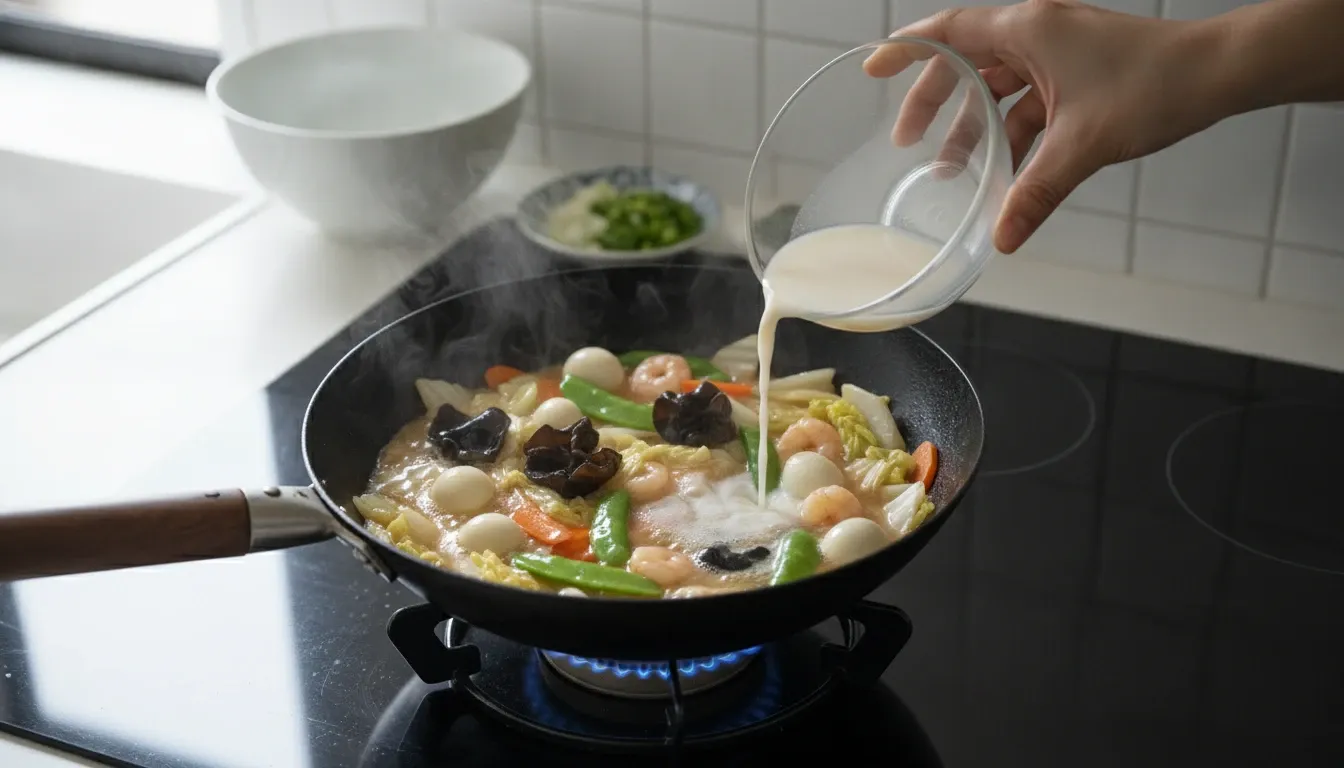
Chinese cooks call this step gou qian (勾芡): starch mixed with water goes into the sauce at the end to thicken it. The thickened sauce clings to the food, so the seasonings dissolved in it reach your mouth along with each bite.
This article covers why Chinese cooking thickens at the end, the four levels of thickness and the dishes they go with, how much slurry to use and when, the starches Chinese cooks use, and how it differs from a French roux.
The ratios for the seasonings you mix in a bowl are in Chinese Stir-Fry Sauce Ratios.
Four levels of Chinese thickening
Chinese cooks sort thickening into four levels, from thickest to thinnest: bao qian, hu qian, liu qian, and mi tang qian.
| Level | How it looks on the plate | Cooking methods | Potato starch (%) | Example dishes |
|---|---|---|---|---|
| Bao qian (包芡, wrapping) | All the sauce clings to the food; almost none left on the plate | Bao (a very hot stir-fry), chao (stir-fry), liu (stir-fried, then coated in thick sauce) | 3–8 | Gong Bao (Kung Pao) chicken, stir-fried pork kidney |
| Hu qian (糊芡, paste) | Sauce and food become one, like a paste | Hui (food simmered in thickened sauce) | 6–9 | Hui fan (rice under a thick, saucy topping), tofu geng (a thick tofu soup) |
| Liu qian (流芡, flowing) | Some clings to the food; the rest flows onto the plate | Shao (braise), pa (braise and plate whole), liu | 4–4.5 | Pa ji (braised whole chicken), tofu braised with crab roe |
| Mi tang qian (米湯芡, rice-water) | The liquid gets only slightly thicker and doesn’t cling | Light braises and soups | 0.8–1 | Braised sea cucumber in soy sauce |
Source: levels, methods and dishes from TVBS and The Paper (references).
For bao qian, the percentage is of the bowl sauce. For the others, it is of the sauce in the pan. These are rough conversions from real recipes and from Japanese home-cooking guides, at 1 tbsp (15 ml) of potato starch = 9 g and 1 tsp (5 ml) = 3 g.
Bao qian depends on how little sauce there is
For bao qian, the percentage is the share of starch in the bowl sauce, the seasonings mixed in a bowl ahead. Gong Bao chicken has about 2 g of starch in about 60 g of sauce (about 3%). Yu xiang xiao hua rou, a fish-fragrant pork stir-fry, has 5 g in about 65 g (Chinese Stir-Fry Sauce Ratios).
As a percentage, bao qian comes out lower than liu qian or hu qian. The amount of sauce is what differs. There is only about 60 g of bowl sauce for 200–300 g of food. It all clings to the surface of the food, so almost nothing is left on the plate.
Where the other percentages come from
The 4–4.5% for liu qian is the usual guide in Japanese home cooking for ankake, a thickened pour-over sauce. The 0.8–1% for mi tang qian is converted from Japanese guides for soups and from a hot and sour soup recipe.
No Chinese source gave a number for hu qian. The 6–9% comes from a single mapo tofu recipe: about 500 g of tofu, 250 ml of stock, and 2–3 tbsp of starch.
Why Chinese cooks thicken at the end
Stir-fries are too quick to reduce
On a home stove, stir-fry 150–200 g at a time; 200 g of bean sprouts take 60–90 seconds (Chinese Cooking Heat Control). In that time, the food overcooks long before the sauce could reduce and thicken.
Potato starch gelatinizes at 55–80°C (131–176°F). Add it to boiling sauce, and it turns clear and thick in about a minute.
A Taiwanese health site gives the reason Chinese cooking thickens with starch. Many dishes are quick stir-fries over high heat. There is no time to reduce the gelatin from meat and bones into a thick sauce.
Dishes that do have time simmer down instead, with no starch. Shanghai cooks call this zi lai qian, self-thickening, as in hong shao rou (pork belly braised in soy sauce). Sweet-and-sour spare ribs also reduce with no starch added.
The thickened sauce counts toward color
On the score sheet of a Cantonese chef skills contest, 4 of the 10 points for color go to the zhi qian, the thickened sauce (Se Xiang Wei Xing).
Potato starch thickens clear. The colors of the sauce and the food show through, and the surface turns glossy. If the sauce clouds over or water pools on the plate, those 4 points shrink.
Thickening holds the water from tofu and vegetables
Tofu and napa cabbage shrink in the heat and push their water into the sauce. That water lowers the share of starch in the sauce and loosens it.
Mapo tofu is known for being thickened in three additions. A Shanghai food article explains why: it stops the tofu from releasing water that pools on the plate.
Slurry ratio and how much starch
1 part starch to 1–2 water; thickness follows the sauce
A Taiwanese guide mixes about 1 part starch to 1.2 parts water for the two thick levels (bao qian and hu qian), and about 1.5 for the two thin ones (liu qian and mi tang qian). Japanese home-cooking guides use 1 to 2.
| Starch : water | After it goes in |
|---|---|
| 1 : 1 | Thickens fast, but lumps easily |
| 1 : 2 | Thickens slowly, with fewer lumps |
Source: Kaden Watch (references).
The slurry’s water joins the sauce too. But 30 ml (2 tbsp) of water in 200 ml of sauce adds only a little over a tenth. What changes the thickness is the amount of starch for the sauce in the pan, much more than the slurry ratio.
Starch for 200 ml of sauce, by level
Here are the percentages for each level, converted to potato starch for 200 ml of sauce.
| Level | Potato starch for 200 ml of sauce (g) | Measuring spoons |
|---|---|---|
| Mi tang qian (soup) | 1.6–2 | 1/2–2/3 tsp |
| Liu qian (pour-over sauce) | 8–9 | Just under 1 tbsp to 1 tbsp |
| Hu qian | 12–18 | 1 1/3–2 tbsp |
Sources: Tokubai (about 1% of the liquid for soups, about 4% for pour-over sauces), macaro-ni (1 tbsp for 200 ml gives a pour-over sauce), hot and sour soup (Vincent Yeow Lim), mapo tofu (Tom Doorley).
Bao qian goes in with the bowl sauce, so it isn’t in this table. With cornstarch instead of potato starch, see the starch section below.
When to add it, and the heat
Season first, then pour into boiling sauce
A Taiwanese guide says adding seasonings or stirring on and on after thickening breaks the sauce. Season with salt, soy sauce and sugar first, then add the slurry.
| Step | What to do | Signal to move on |
|---|---|---|
| 1 | Bring the sauce to a boil and season it | The sauce boils, and the salt tastes right |
| 2 | Stir the slurry up from the bottom | No white starch left at the bottom of the bowl |
| 3 | Stir the sauce with a ladle while you pour in a thin stream | The sauce turns cloudy white |
| 4 | Keep stirring and bring it back to a boil | The sauce turns clear and glossy |
| 5 | Turn off the heat. For dishes with ming you, drizzle it on, then plate | — |
Sources: TVBS (no seasonings after thickening), this site’s article on starch gelatinization (stop once it boils and turns clear).
Japanese home-cooking guides also give another order: bring the sauce to a boil, turn off the heat, stir in the slurry, then heat again. With the heat off, the starch doesn’t set all at once, so lumps form less. If you add it to a wok over high heat, keep stirring the sauce with the ladle to stop lumps.
For soup, thicken before the egg
Hot and sour soup recipes add the vinegar, thicken with the slurry, check the thickness, and only then add the beaten egg. Pour the egg in a thin stream into thickened soup, and it spreads into fine petals.
Vinegar cuts the starch network and loosens the thickening. Once the vinegar is in, thicken, add the egg, boil about 10 seconds over high heat, and turn off the heat.
Add it in 2–3 parts when food releases water
With fillings that release water, such as tofu and napa cabbage, add the slurry in 2–3 parts. Add the last part just before plating.
The Shanghai dish xiang you shan hu, stir-fried swamp eel strips under sizzling oil, is thickened twice: thick first, then thin.
Ming you goes on after thickening
Ming you, oil drizzled over at the end, goes in after the sauce has thickened (Ming You). For a pour-over sauce, drizzle 1 tsp (5 ml) per serving, give one big stir, and plate.
Stirring on and on after the oil also breaks the thickening, cooks say. Taiwanese cooks call a broken thickening tuo qian.
Potato starch and other Chinese starches
Chinese cooks call thickening starch dianfen (淀粉), and use different kinds by their source. Japanese potato starch, sold as katakuriko, is almost always made from potatoes.
Potato starch is tudou dianfen; cornstarch thickens gently
| Starch | Chinese name | Gelatinizes at | Strength and color | When it cools |
|---|---|---|---|---|
| Potato starch | Tudou dianfen (土豆淀粉), malingshu dianfen (馬鈴薯淀粉) | 55–80°C (131–176°F) | Strong, clear | Loosens |
| Cornstarch | Yumi dianfen (玉米淀粉) | 60–76°C (140–169°F) | Medium, cloudy white | Holds |
Sources: gelatinization temperatures, thickening strength and behavior when cold from this site’s articles on starch gelatinization and starch thickening.
Many English-language Chinese recipes thicken with cornstarch (cornflour in the UK). Potato starch thickens more than cornstarch, so don’t add a cornstarch amount all at once. Add half, bring it to a boil, check the thickness, and add the rest as needed.
Going the other way, if you only have cornstarch, use 1 tbsp of it for every 2 tsp of potato starch in this article. Cornstarch also needs a couple of minutes at a simmer to thicken fully.
Sweet potato starch is stickier and coarser
On a Taiwanese science program, rou geng (a thick pork soup) was thickened with four starches. Sweet potato starch (di gua fen) was the stickiest. Its grains are coarse, and it gives a thickening you can feel in your mouth.
Taiwanese cooks use sweet potato starch for dishes thickly coated in sweet-sour sauce, such as gu lao rou (Cantonese sweet-and-sour pork). For hu qian and mi tang qian, they use tai bai fen.
Tai bai fen was originally potato starch, but some products substitute starch from cassava (tapioca).
Mung bean starch is also used for thickening, but its properties and gelatinization temperature could not be confirmed.
Bowl sauce, ming you, and the oils
Here are the Chinese techniques used in the same wok, in the order they go in.
| Technique | What it does | When it goes in |
|---|---|---|
| Shu you | Cooks off the oil’s raw smell | Before use |
| Flavored oil | Infuses aroma into the oil | At the start of the stir-fry |
| Bowl sauce | Mixes the seasoning ratio and the starch in a bowl | Once, at the end of cooking |
| Gou qian | Thickens the sauce so it coats the food | In stir-fries, with the bowl sauce; in simmered dishes, after seasoning |
| Ming you | Adds an oil for gloss and aroma | After the sauce thickens |
The bowl sauce carries the flavor itself. Gou qian is how that flavor gets onto the food. In a stir-fry, the starch is already in the bowl sauce, so flavor and thickening go in at once (bao qian).
In simmered dishes and soups, the slurry goes in separately after seasoning (liu qian, mi tang qian). With bao qian, you taste the concentrated flavor on the food’s surface. With liu qian, you taste the sauce you scoop up with the food. With mi tang qian, you taste the liquid itself.
For a stir-fry where you want the food wrapped in strong flavor, use bao qian. For a dish whose sauce goes over rice, use liu qian. For a soup you drink, use mi tang qian. For extra gloss and aroma, add ming you after the thickening.
Roux goes in first, gou qian last
French cooking thickens sauces with starch too. What differs is when the flour goes in, and which kind.
| French roux | Chinese gou qian | |
|---|---|---|
| Starch | Wheat flour | Potato starch or another pure starch |
| Preparation | Cooked in butter | Mixed with water |
| When it goes in | Before the liquid (first) | After the sauce is seasoned (last) |
| Starch to liquid (%) | Soups 2–5, pour-over sauces 5–8 | Soups 0.8–1, pour-over sauces 4–4.5 |
| Finish | White and opaque | Clear and glossy |
Sources: this site’s articles on roux, sauce consistency, and starch thickening.
Potato starch has large granules that swell into a strong thickening, so it needs a lower percentage than wheat flour.
A roux is flour cooked first in butter, then thinned with liquid into the base of a sauce. Gou qian goes into a finished sauce last, which you then bring to a boil to thicken.
When to change the method
| Situation | What to do | Why |
|---|---|---|
| Less sauce in the pan than the recipe says | Work out the starch from the sauce that’s left (half the sauce, half the starch) | Thickness follows the starch for the sauce |
| Fillings that release water, such as tofu or napa cabbage | Add it in 2–3 parts, the last just before plating | Water from the food loosens the thickening |
| A soup with vinegar | After the vinegar, add the thickening and egg in a row; boil about 10 seconds and stop | Vinegar cuts the starch network |
| Eating it cold | Thicken with cornstarch | Potato starch thickening loosens as it cools |
| Making a cornstarch recipe with potato starch | Add half, bring it to a boil, check the thickness, then add the rest | Potato starch thickens more |
Sources: this site’s article on starch thickening, The Paper, Bendibao (references).
Common failures and fixes
Lumps can be only partly saved. The other four can be fully fixed.
| Problem | Cause | Fix it now | Prevent it next time |
|---|---|---|---|
| The sauce is lumpy | Starch settled at the bottom of the bowl rushed in at once. The hot sauce gelatinized only the outside of each clump, sealing dry starch inside | Lower the heat, stir quickly with a ladle to break it up, and scoop out any lumps left | Stir the slurry up from the bottom just before adding it, and pour in a thin stream while stirring the sauce |
| It won’t thicken | The heat went off before the sauce boiled. The starch never reached the 80°C (176°F) it needs to gelatinize fully, so the granules didn’t swell all the way | Stir and bring it to a boil once, and keep it on the heat until the sauce turns clear and thick | After adding the slurry, wait until it boils and turns clear before turning off the heat |
| It’s too thick | The sauce had reduced, but all the starch in the recipe still went in, so the share of starch rose | Add water, hot or cold, 15 ml (1 tbsp) at a time, stirring, and bring it back to a boil | Add half the slurry, bring it to a boil, check the thickness, then add the rest |
| The thickening breaks | It kept boiling and being stirred after it thickened, so the swollen starch granules broke and lost their hold | Add a little more slurry, and plate as soon as it boils and turns clear | Turn off the heat once the sauce clears, and after the ming you, give only one big stir |
| Water pools on the plate | Tofu or napa cabbage shrank in the heat and released water, lowering the share of starch in the sauce | Add a little more slurry, bring it back to a boil, and gather the released water into the sauce | Add the slurry in 2–3 parts, the last just before plating |
Four things to remember
Chinese thickening means adding a starch slurry to seasoned sauce, bringing it to a boil once until clear, and letting the sauce coat the food.
- There are four levels: bao qian, hu qian, liu qian and mi tang qian. As starch to sauce, a pour-over sauce (liu qian) is 4–4.5%, and a soup (mi tang qian) is 0.8–1%
- For bao qian in a stir-fry, the starch goes in the bowl sauce, so flavor and thickening go in at once. About 60 g of bowl sauce for 200–300 g of food
- The slurry is 1 part starch to 1–2 parts water. The thickness depends not on that ratio, but on the starch for the sauce left in the pan
- Turn off the heat once the sauce clears. For dishes with ming you, drizzle it on then, and give only one big stir
Potato starch is the same starch Chinese cooks call tudou dianfen. With a recipe written for cornstarch, start with half the amount and check the thickness.
Sources
- TVBS Health 2.0. Gou qian. On the four levels bao qian, hu qian, liu qian and mi tang qian and the cooking methods they go with, starch-to-water ratios of about 1:1.2 and 1:1.5, and how stirring after thickening makes it break (in Chinese)
- The Paper (Food and Life). Qiao Zhiyuan. Shanghai-style starch sauces show a cook's skill. October 28, 2023. On bao qian, hu qian and liu qian in Shanghai dishes, zi lai qian, thickening twice, and thickening mapo tofu three times (in Chinese)
- foodNEXT. How sweet-and-sour pork locks in its flavor: the starch-and-water dance of gou qian. May 28, 2020. On a comparison of four starches, and when to use sweet potato starch or tai bai fen (in Chinese)
Show 8 more
- EDH (Good Morning Health). Lu Weizhen. A thickened white fungus dish that won't add weight. April 21, 2023. On why Chinese cooking thickens with starch, and what Taiwanese tai bai fen is made from (in Chinese)
- Tokubai GOHAN-MAYU (registered dietitian). Tips for thickening with potato starch. On about 1% of the liquid for soups and about 4% for pour-over sauces (in Japanese)
- macaro-ni. How to make potato starch slurry. On 1 tbsp of potato starch with 2 tbsp of water thickening 200 ml of liquid to a pour-over sauce (in Japanese)
- Kaden Watch. Jun (registered dietitian). Keeping potato starch slurry from lumping in pour-over sauces. February 21, 2025. On 2 parts water to 1 part starch thickening slowly with fewer lumps, and adding it with the heat off (in Japanese)
- Bendigo Advertiser. Vincent Yeow Lim recipes from The Wolf of Wok Street cookbook. On hot and sour soup: 1 tbsp of starch mixed with 120 ml of water for 1 L of chicken stock
- Bendibao. Home-style hot and sour soup. On the order: thicken after the vinegar, check the thickness, add the beaten egg, and boil 10 seconds over high heat (in Chinese)
- Asia Market (Tom Doorley). My Way With Mapo Tofu. On about 500 g of tofu, 250 ml of stock, and 2–3 tbsp of starch mixed with cold water and added a little at a time
- America's Test Kitchen. Can potato starch be substituted for cornstarch to thicken sauces? (potato starch thickens more and faster; 2 tsp potato starch for 1 tbsp cornstarch)