What this article answers
- What Chinese stock (tang) is
- Umami drawn from chicken and pork bones and meat in advance. Almost no salt or fat
- Why Chinese cooking builds on stock
- Before MSG, only stock gave umami, and a 60–90 second stir-fry has no time to draw it out
- When to use clear stock or white stock
- Clear for dishes where you drink the liquid, white for a rich body, mao tang for stir-fries
- How much bouillon powder replaces stock
- About 1.7 g per 100 ml of stock. Cut soy sauce by just under 5 ml (1 tsp) for its 0.8 g of salt
- How it differs from Japanese dashi
- Dashi is made for each dish. Chinese cooks keep one pot and use it across dishes
The ingredient list of a Chinese recipe often has a line where stock goes in instead of water: “200 ml stock,” “1 tbsp chicken stock.” Gong Bao (Kung Pao) chicken takes 15 ml (1 tbsp) in its sauce, and mapo tofu takes 250 ml.
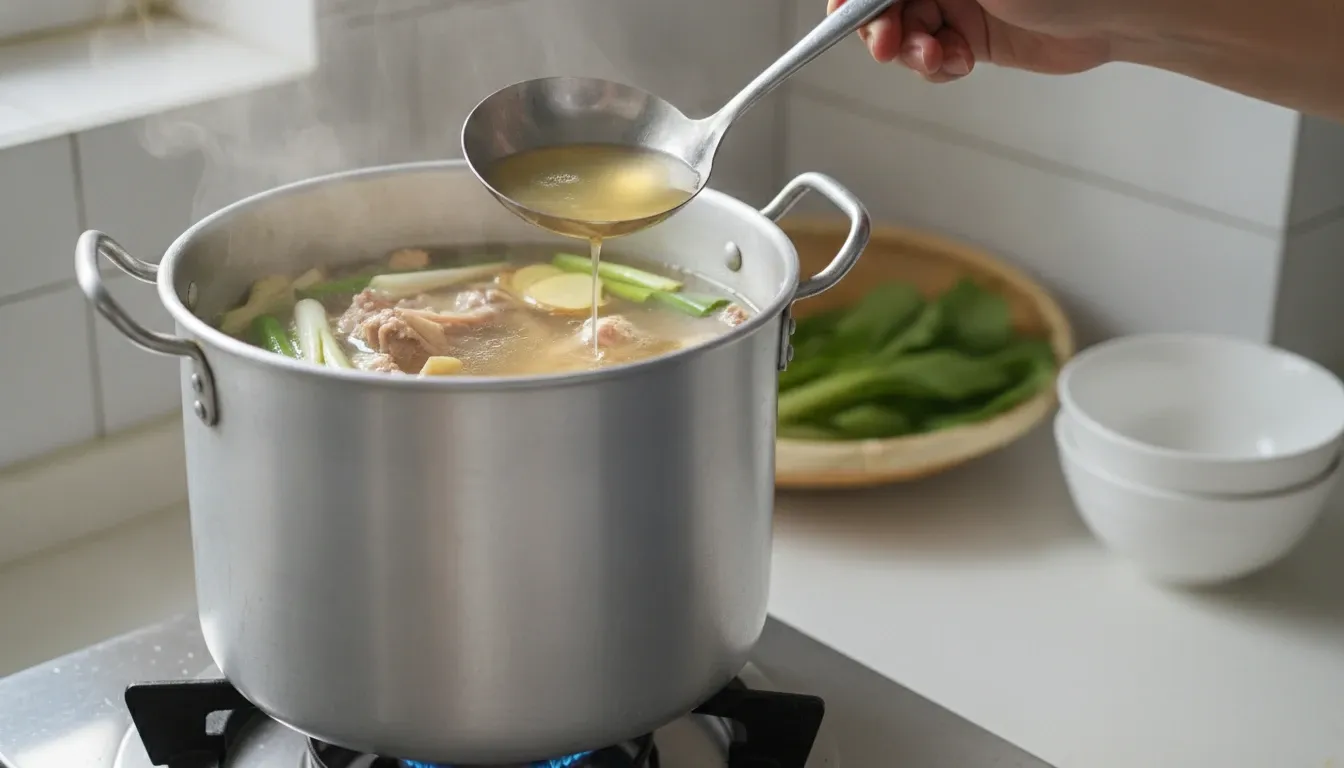
Stock, tang (汤) in Chinese, is a liquid that holds umami drawn from chicken and pork bones and meat in advance. Chinese cooking uses it in place of water, as the base of a dish’s flavor.
This article covers why Chinese cooking puts stock at the base, which dishes get clear stock (qing tang) and which get white stock (bai tang), and how much bouillon powder to use at home and how to adjust the salt.
How to make each stock (ingredients, heat, time) is in Chinese Stock Types. The ratios for the sauce built on top of the stock are in Chinese Stir-Fry Sauce Ratios.
Chinese stock is umami drawn out in advance
The Chinese word for umami is xian wei (鲜味). Shandong cooking calls stock “the source of a hundred xian wei,” and has long used clear qing tang and milky nai tang for different dishes.
By the dishes it goes into, stock comes in four kinds.
| Stock | Look and taste | Used for | Example dishes |
|---|---|---|---|
| Mao tang (basic stock) and er tang (second stock) | Slightly cloudy | Stir-fries and braises with a little liquid | Stir-fry sauces, mapo tofu, chili shrimp |
| Qing tang (clear stock) | Clear, with clean umami | Dishes where you drink the liquid; pale vegetables shown off in stock | Kai shui bai cai (napa cabbage in clear stock, Sichuan), qing tang shi jin (assorted ingredients in clear stock, Shandong) |
| Shang tang (superior stock) | Clear, with the umami of dried goods layered on | Banquet dishes; greens cooked in stock | Shang tang cai xin, choy sum in superior stock (Cantonese) |
| Bai tang (white stock; nai tang in Shandong) | Milky, with body | Dishes eaten for the richness of the liquid | Nai tang pu cai (cattail shoots in milky stock, Shandong); white-stock hot pots and noodles |
Sources: example dishes from Sina Travel, NetEase, and DELISH KITCHEN (see references). Uses of mao tang from Chinese Stock Types.
Mao tang is stock from chicken carcasses and pork bones simmered on low heat for about 3 hours. Qing tang, shang tang, and er tang all start from it.
Qing tang is made by clearing mao tang with ground meat, or straight from water with ground meat. Shang tang is qing tang with the umami of dried goods such as Jinhua ham added. Er tang is a second stock: water added to ingredients already used once, then extracted again.
Bai tang is a separate line. Ingredients high in collagen and fat, such as pig’s trotters and chicken feet, are boiled hard until the stock turns cloudy white (Chinese Stock Types).
Gao tang (高汤) in a recipe means stock from meat, chicken, or duck, or simply stock in general.
Why stock became the base
Before MSG, only stock could make umami
Chinese cooks have a saying: 唱戏的腔,当兵的枪,厨子的汤. An actor has his voice, a soldier his gun, a cook his stock. A Taiwanese newspaper quotes it too, and writes that a cook who can’t make stock can’t make a living.
A Chinese investigative report explains it this way. Before MSG (wei jing, 味精), the only way to get xian wei was stock, long simmered from chicken, beef, pork, and seafood.
Old Shandong restaurants spoke of “one pot of stock.” They made a pot before service, and when it ran out, they closed, even with customers waiting.
The same report says MSG later spread, and sprinkling it became quicker than making stock. Chicken bouillon powder in a home kitchen lists chicken extract and MSG among its ingredients too.
A 60–90 second stir-fry can’t draw out umami
On a home stove, stir-fry 150–200 g at a time; 200 g of bean sprouts is done in 60–90 seconds (Chinese Cooking Heat Control).
Umami from meat and bones takes time to come out. Mao tang simmers on low heat for about 3 hours. A 90-second stir-fry is about 1/120 of that.
So a little stock, drawn out over hours beforehand, goes in at the end of the stir-fry. The bowl sauce for Gong Bao chicken uses 15 g of stock for 300–350 g of chicken breast (Chinese Stir-Fry Sauce Ratios).
That 1 tbsp of stock carries umami that took 3 hours to draw from bones.
Almost no salt or fat, so they go in separately
| Liquid (per 100 g) | Fat (g) | Salt equivalent (g) |
|---|---|---|
| Chinese stock | 0.0 | 0.1 |
| Chicken-bone stock | 0.4 | 0.1 |
Source: Standard Tables of Food Composition in Japan 2020 (8th revised edition), stocks.
Stock carries only umami, with almost no salt or fat. So Chinese cooks add salt with soy sauce and salt, aroma with oil, and body with starch, each separately from the stock, and can change each amount. How aroma goes into oil is in Chinese Flavored Oils, and thickening is in Thickening Chinese Sauces.
Choose clear or white stock by the liquid
Clear stock for broth you drink and colors you show
Kai shui bai cai is a Sichuan dish of napa cabbage hearts served in clear qing tang. Kai shui means boiled water. The name says the stock is so clear it looks like plain hot water.
With no cloudiness, the color of napa cabbage, tofu, or greens shows through. In dishes where you drink the liquid, the stock’s flavor is the dish’s flavor. Cantonese dishes that cook greens in stock, such as choy sum in superior stock, use shang tang, which layers dried-goods umami on top of qing tang.
Boiling clouds qing tang. Keep it at around 94°C (201°F), where the surface barely trembles (Chinese Cooking Heat Control).
White stock for dishes eaten for their body
Bai tang turns white because gelatin from the bones spreads fat through the water in tiny droplets (Chinese Stock Types). In the mouth, it has more body and thickness than qing tang.
Nai tang pu cai, from Shandong, simmers mild cattail shoots in milky stock and lets the stock’s richness carry the dish. At home, use bai tang as the broth for hot pots and noodles, in dishes where the liquid matters more than what’s in it.
Bai tang is kept boiling at about 100°C (212°F): bring it to a boil on high heat, then cook it on medium for 2–3 hours (Chinese Cooking Heat Control). Restaurant bai tang, made with more ingredients, cooks for 6 hours (Chinese Stock Types).
Mao tang for stir-fries and braises with little liquid
The sauce for a stir-fry takes about 15 ml (1 tbsp) of stock. Even mapo tofu uses 250 ml for about 500 g of tofu (Thickening Chinese Sauces). Soy sauce and doubanjiang (chili bean paste) layer their color and flavor on top, so whether the stock was clear doesn’t show on the plate.
For these everyday dishes, cooks use mao tang, which skips the work of clearing, or er tang from ingredients already used once.
| What the dish shows | Stock to choose |
|---|---|
| The liquid you drink, the color of the ingredients | Qing tang (shang tang for a banquet) |
| The body and thickness of the liquid | Bai tang |
| Little liquid, colored by soy sauce or doubanjiang | Mao tang, er tang, or bouillon powder |
How much bouillon powder replaces stock
If you make stock at home, qing tang made from water with ground meat takes only 30 minutes. Use 350 g of ground chicken plus lean ground pork for 2 L of water (Chinese Stock Types). With no time for that, use chicken bouillon powder.
Bouillon powder is stock and salt in one spoon
Ajinomoto’s Marudori Gara Soup, a chicken bouillon powder sold in Japan, weighs about 2.5 g per teaspoon, and 1.2 g of that is salt. About half its weight is salt.
The maker’s guide for soup is 4 teaspoons (about 10 g) in 600 ml of water. For 100 ml of stock, that is about 1.7 g (2/3 tsp), carrying about 0.8 g of salt. The liquid is about 0.8% salt, seasoned to drink as soup.
Real stock has only 0.1 g of salt in the same 100 ml. Swap in powder, and salt comes in with the stock. If the recipe then adds soy sauce or salt, the salt goes in twice.
Brands differ, so check your own label. If it lists sodium instead of salt, multiply sodium by 2.5 to get salt.
Match the powder and the soy sauce to the stock
How much powder to use in place of the stock in a recipe:
| Stock in recipe (ml) | Example dish | Bouillon powder (g) | Measure (tsp) | Salt from the powder (g) | How to adjust |
|---|---|---|---|---|---|
| 15 | Stir-fry sauce | 0.25 | 1/10 | 0.12 | Use water, or a pinch of powder |
| 200 | Dishes in a thickened sauce | 3.3 | 1 1/3 | 1.6 | Cut soy sauce by just under 10 ml (2 tsp) |
| 250 | Mapo tofu | 4.2 | 1 2/3 | 2.0 | Cut soy sauce by about 12 ml (2 1/3 tsp) |
| 1000 | Soups such as hot and sour soup | 16.7 | 6 2/3 | 8.0 | Leave out the recipe’s salt and taste |
Sources: converted at about 1.7 g per 100 ml of stock, from Ajinomoto’s Marudori Gara Soup (1 tsp = about 2.5 g with 1.2 g salt equivalent; 4 tsp in 600 ml of water for soup). Soy sauce is regular Japanese soy sauce (koikuchi, the kind in a standard Kikkoman bottle) from the Standard Tables of Food Composition in Japan (8th revised edition): about 0.87 g of salt in 1 tsp (6 g).
With 100 ml of stock or more, the salt from the powder adds up to just under 5 ml (1 tsp) of soy sauce or more. Cutting soy sauce also cuts its aroma. To keep the aroma, use half the guide amount of powder and the full amount of soy sauce from the recipe.
Powder can’t give bai tang its whiteness and body
Ajinomoto’s powder has only 0.34 g of protein per teaspoon (2.5 g). Bone gelatin, which makes bai tang white and thick, hardly comes from granules at all.
Powder can stand in for what mao tang and qing tang do: add umami. To make a bai tang dish at home, boil collagen-rich cuts such as chicken wings or pig’s trotters hard (Chinese Stock Types).
How stock fits with sauces, starch, and oils
Here are the Chinese techniques used in the same wok, in the order they go in.
| Technique | What it does | When it goes in |
|---|---|---|
| Shu you | Drives raw smells out of the oil beforehand | Before cooking |
| Stock | Umami drawn out in advance, used in place of water | In stir-fries, with the bowl sauce; in braises and soups, from the start |
| Flavored oil | Moves aroma into oil | At the start of the stir-fry |
| Bowl sauce (wan zhi) | Sugar, vinegar, soy sauce, and starch mixed in a bowl with stock or wine | Once, at the end of cooking |
| Thickening (gou qian) | Thickens the liquid so it coats the food | After the seasoning is set |
| Ming you | Oil drizzled over for gloss and aroma | After the sauce has thickened |
Stock is the layer the other techniques sit on. The sweet-and-sour or soy-based sauce and the thickened liquid are all made with stock, not water. So the liquid that reaches your mouth already carries umami.
Swap the stock for water, and the ratios of the sauce and the thickness stay the same. Only the umami in the liquid changes. When a dish tastes flat, what’s missing may be umami, not salt.
Dashi per dish, Chinese stock in one pot
Japanese cooking also puts a stock, dashi, at the base of its flavor. The differences are what the umami comes from and how the liquid is kept.
| Japanese dashi | Chinese stock | |
|---|---|---|
| Main ingredients | Kombu (dried kelp), katsuobushi (dried, smoked bonito) | Chicken carcasses, pork bones, meat; dried goods (Jinhua ham, dried scallops) |
| How fast umami comes out | Quickly, then it’s spent | Keeps coming from bones for a long time (about 3 hours for mao tang) |
| Direction of second extractions | The first dashi is the top; the second is weaker | Mao tang is the base; clear it for qing tang, add dried goods for shang tang, building upward |
Sources: Chinese Stock Types and this site’s article on umami in Japanese cooking.
Kombu and katsuobushi give up their flavor quickly. So Japanese cooks make dashi for each dish and put their effort into the first extraction.
Bones keep releasing flavor. So Chinese cooks simmer one stockpot and keep it on hand. For each dish, they use it as mao tang, clear it into qing tang, or add dried goods for shang tang. The “one pot of stock” of old Shandong restaurants describes exactly this way of keeping it.
Both stack glutamate and inosinate to boost umami. That part is the same in Japanese dashi and Chinese stock.
What makes it work
| When | What to do | Why |
|---|---|---|
| Swapping a recipe’s stock for bouillon powder | About 1.7 g per 100 ml of stock. Cut soy sauce by just under 5 ml (1 tsp) for the powder’s salt (about 0.8 g) | The powder is about half salt, about 8 times the 0.1 g of salt in real stock |
| You don’t want to lose the soy sauce aroma | Use half the guide amount of powder; keep the soy sauce as written | Cutting soy sauce cuts its aroma too |
| The stir-fry sauce has 1 tbsp of stock | Use water, or a pinch of powder | 0.25 g of powder is 0.12 g of salt, too little to change the seasoning |
| Showing napa cabbage or tofu in clear broth | Use qing tang, held at around 94°C without boiling | Boiling breaks up the fat and clouds it |
| Hot pots and noodles eaten for the broth’s body | Use bai tang. At home, boil chicken wings or pig’s trotters hard | The whiteness and body come from bone gelatin, not from granules |
Common failures and fixes
Missing umami can be fully fixed. An over-salted dish and cloudy stock can be only partly saved.
| Problem | Cause | Fix it now | Prevent it next time |
|---|---|---|---|
| Too salty | Bouillon powder is about half salt by weight. The recipe’s stock was swapped for powder, then the recipe’s soy sauce and salt went in as written, so the salt went in twice | Thin it with water or a salt-free stock. If the dish is thickened with starch, check the thickness and add a little more | Take the powder’s salt (about 0.8 g per 100 ml of stock) off the soy sauce or salt first |
| No umami | The recipe’s stock was swapped for water. A short stir-fry or simmer can’t draw enough umami from the ingredients | Dissolve bouillon powder at about 1.7 g per 100 ml of stock and add it; hold back soy sauce for the powder’s salt | For recipes with 100 ml of stock or more, use stock or powder dissolved in water, not plain water |
| The stock went cloudy | Qing tang kept boiling. Bubbles and currents broke the fat into fine droplets that spread through the water and scatter light | Use the cloudy stock as bai tang in braises or hot pots; make fresh stock for dishes that need it clear | Once qing tang boils, turn it down and hold it at around 94°C, where the surface barely trembles |
Four things to remember about Chinese stock
Chinese stock is umami drawn from chicken and pork bones and meat in advance, used in place of water.
- Before MSG, Chinese cooking made xian wei with stock. A 60–90 second stir-fry has no time to draw umami from the ingredients, so stock drawn out over hours goes in.
- Stock has almost no salt or fat and carries only umami. Salt, aroma, and thickening go in separately, each in its own amount.
- Use qing tang for dishes where you drink the liquid and show the ingredients’ color, bai tang for dishes eaten for the body of the liquid, and mao tang for stir-fries and braises with a little liquid.
- To replace stock with bouillon powder, use about 1.7 g per 100 ml. Cut soy sauce by just under 5 ml (1 tsp) for the 0.8 g of salt it brings.
Sources
- The Paper (Liaowang Think Tank), Li Haoran and Wang Qixin. "What makes Shandong cuisine first of the eight great cuisines?" December 19, 2018 (in Chinese). The saying "an actor's voice, a soldier's gun, a cook's stock"; how stock gave xian wei before MSG; the "one pot of stock" in Shandong restaurants; MSG later replacing stock
- Commercial Times (Taiwan), Yao Shun. "A renaissance of tang: tasting Taiwan in The One's soups" July 3, 2020 (in Chinese). The saying "an actor's voice, a cook's stock"; a cook who can't make stock can't stand on his own
- Sina Travel. "The evolution of Shandong cuisine" October 19, 2009 (in Chinese). Qing tang and nai tang in Shandong cooking: qing tang clear and fresh, nai tang white and mellow; qing tang shi jin and nai tang pu cai
Show 5 more
- Jiemian, Er Mao. "First of the eight great cuisines: this is Shandong cuisine" (in Chinese). Shandong cooking treats stock as the source of all xian wei and keeps clear and milky stocks distinct
- NetEase. "Can you make the shang tang, gao tang, qing tang, tou tang, and er tang of Cantonese cooking?" September 16, 2017 (in Chinese). Ingredients and uses of Cantonese shang tang (choy sum in superior stock, shark fin over rice); Sichuan qing tang for kai shui bai cai; er tang for seasoning everyday dishes
- Ajinomoto Co. "Marudori Gara Soup" product details (in Japanese). About 2.5 g per teaspoon; 1.2 g salt equivalent and 0.34 g protein per 2.5 g serving; 4 teaspoons per 600 ml of water for soup for four; ingredients
- DELISH KITCHEN. "Paitan soup recipes and what the characters mean" February 16, 2021 (in Japanese). Using bai tang for noodles, hot pots, and rice porridge
- nidirect (Northern Ireland government). "Salt". Salt = sodium x 2.5